The Story of Gigō Funakoshi: Karate as Reconstruction

Milton Chanes • August 2, 2026

Share this article

Karate as Personal Reconstruction

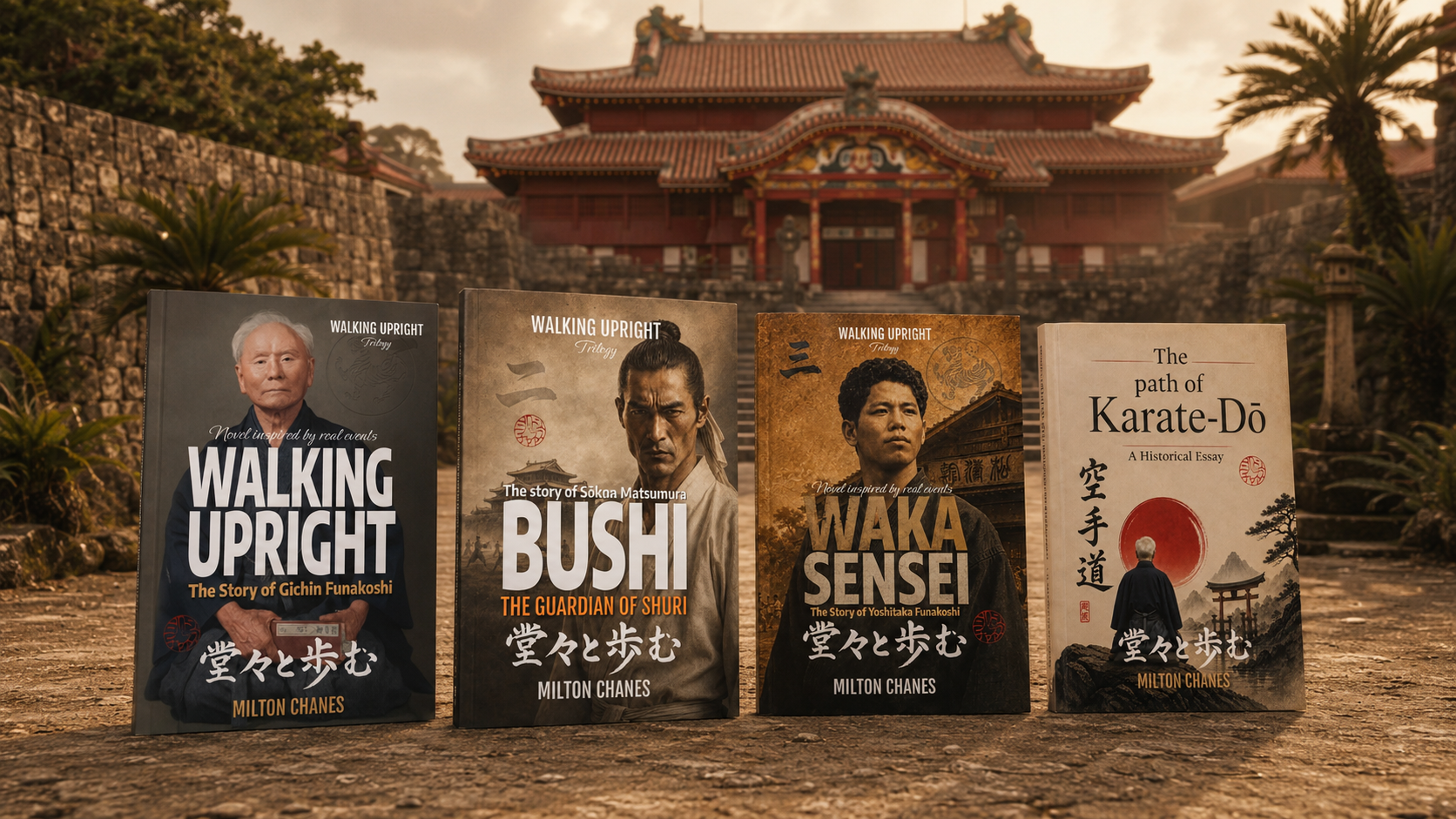
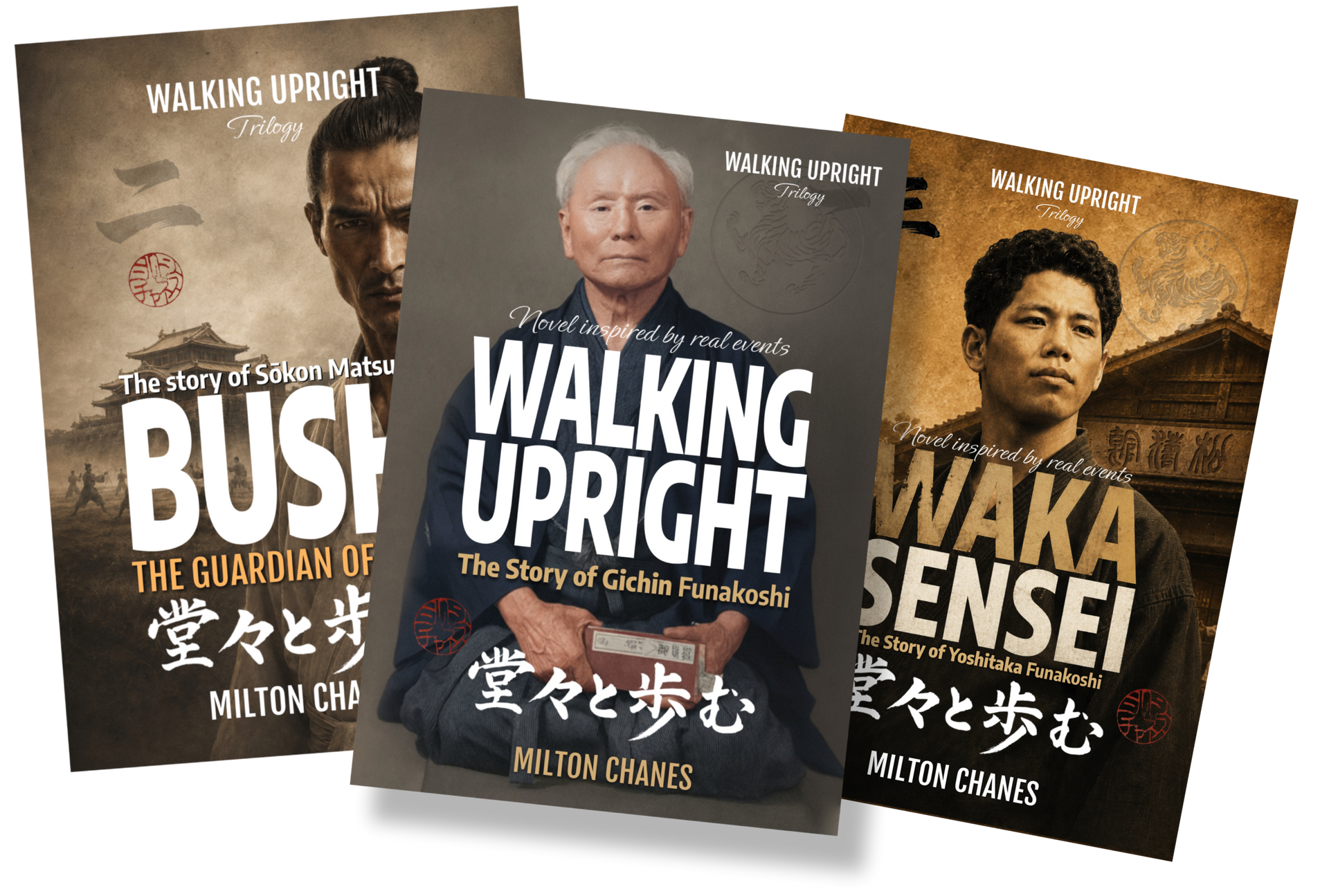
In Walking Upright, the first novel in the trilogy, I experiment with telling a story across two different timelines. The narrative present is set in 1945, after the bombing of Tokyo. From within that devastated world, the parallel chapters begin to reconstruct the past. The present of 1945 helps the reader travel backwards in order to understand how everything came to that point. Because that present is not our own either: it too must be discovered, interpreted, and understood.

In this way, the novel explores some of the most important moments in the life of Gichin Funakoshi. Some are historically documented. Others belong to stories passed down through generations, to the memories of his students, or to the legends that eventually grew around his figure. Still others belong to fiction—not to replace history, but to try to narrate what probably happened, even though we can no longer know exactly how it occurred.

The second book, Bushi: The Guardian of Shuri, dedicated to Matsumura Sōkon, was born from the same idea.

In this case, the journey takes us to a much less thoroughly documented Okinawa—a world in which history, oral tradition, and legend are constantly intertwined. This lack of certainty makes it possible to work with the surviving stories and construct a narrative about the final years of the Ryūkyū Kingdom.

Through Sakugawa and Matsumura Sōkon, the reader can observe how certain combat practices were transmitted, transformed, and adapted until Tōde eventually became one of the foundations of what, over time, would come to be known as Karate-dō.

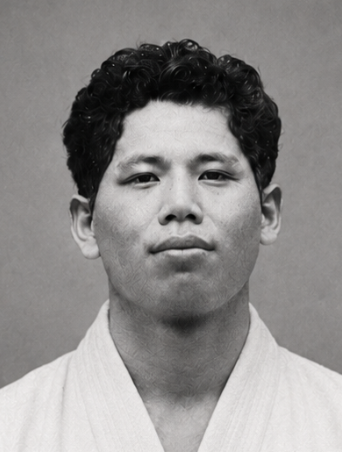
And then we arrive at the third book: the story of Gigō Funakoshi.

It is important to make one thing clear from the beginning: Gigō did not create the Shōtōkan style. Neither did his father.

These novels are not about the “Shōtōkan style.” They are about real people who participated in the modernisation of karate and who were involved in the early stages of a much broader transformation.

When I speak of modernisation, I mean a process that began approximately a century ago. I am referring to what we now commonly consider traditional karate, not to its later development as a competitive sport.

Nevertheless, many of the questions that arose during that transformation remain open. Definitive answers do not always exist, but understanding the context in which those questions first appeared can help us better comprehend the karate that has reached us today.

A different novel

The novel about Gigō is different from the previous books in the trilogy.

The story begins from the perspective of a child who grows while trying to understand the world around him. First, he discovers his own body: its weaknesses, its limitations, and the illness that threatens to shorten his life. Later, he begins to understand that this body can also be trained, educated, and transformed.

Gigō first uses Tōde, and later karate, as a form of self-reconstruction.

Perhaps also as a cure.

Or perhaps simply as a path that might allow him to prolong his life for as long as possible, beyond what the doctors had predicted for him.

His relationship with karate does not arise solely from a desire to learn how to fight. It is born from the need to change himself—to strengthen a fragile body and find a discipline that will allow him to keep moving forward when illness seems to have already decided his fate.

And perhaps this story will feel familiar to many readers.

How many of you began practising karate because a doctor, a teacher, or your own parents thought it might help you?

Children who could never remain still.

Those who felt shy or insecure.

Those who suffered bullying.

Those who found it difficult to relate to other people.

Those who could never find their place in team sports.

Does any of this sound familiar?

Karate has always been this as well. Not merely a form of combat, but a tool for learning how to inhabit one’s own body, control fear, relate to others, and build a stronger version of oneself.

The story of Gigō Funakoshi is one of those stories.

The story of a child who received a diagnosis but refused to accept that it should completely determine who he would become.

The story of someone who transformed his fragility into the starting point of a profound transformation.

The story of a man who may not have defeated his illness, but who managed to live longer, create more, and leave a far deeper mark than anyone could have imagined.

I believe you are going to enjoy this novel. I am convinced of it.

I wrote the previous two novels in order to reach this story—a story much closer to all of us than you might imagine, one that goes beyond the particular style of karate you practise. It even goes beyond the martial art you practise.

Many martial arts today have been influenced, directly or indirectly, by what happened at this particular place and moment in history.


Oss.

Recent Posts

Gigō Funakoshi: el karate como reconstrucción personal
By Milton Chanes August 2, 2026
Descubre la historia de Gigō Funakoshi, hijo de Gichin Funakoshi, y cómo convirtió el karate en un camino de reconstrucción y transformación personal.
By Milton Chanes July 22, 2026
Genealogy of the Funakoshi Family
By Milton Chanes July 22, 2026
Genealogy of the Funakoshi Family
Geneología de Gichin Funakoshi
By Milton Chanes July 22, 2026
Una investigación sobre los hijos poco documentados de Gichin Funakoshi, las lagunas de su genealogía y la historia familiar detrás del karate moderno.
By Milton Chanes July 18, 2026
Gigo Funakoshi: The Young Master Who Sustained Karate Through Its Most Difficult Years
By Milton Chanes July 10, 2026
Studying these books allows us to follow the transformation of an Okinawan fighting art into Karate-Dō: a journey shaped by teachers, students, historical events, and the vision of a man who dedicated his entire life to transmitting the Way of the Empty Hand.
Karate-Dō Kyōhan
By Milton Chanes July 10, 2026
The most widely accepted version among karate practitioners today connects the famous tiger with Karate-Dō Kyōhan, published in 1935. There are good reasons for this association, and Japanese institutional sources explicitly connect Kosugi with a tiger design for that later work.
Kosugi Hoan (1881–1964) and the Shotokan Tiger: The Artist Behind Funakoshi’s First Karat
By Milton Chanes July 9, 2026
Discover Walking Upright, Milton Chanes’ historical novel inspired by Gichin Funakoshi and the transformation of Tōde into modern Karate-Dō.
Show More