


Kōdōkan – Its History
The Kōdōkan: Where Judo Became a Way and Karate Found Its Gateway to Japan
In 1922, when Gichin Funakoshi first crossed the threshold of the Kōdōkan in Tokyo, he was not simply entering a dojo. That place represented a new way of understanding the martial arts: not merely as methods of combat, but also as instruments of education, discipline, and character development.
For a master arriving from Okinawa, carrying an art that was still largely unknown throughout Japan, appearing before Jigorō Kanō and the country’s leading judoka meant subjecting karate to one of its most important tests. Yet, to fully understand the significance of that encounter, it is first necessary to understand what the Kōdōkan truly was and why it had been founded.
The Birth of the Kōdōkan
The Kōdōkan was founded by Jigorō Kanō in May 1882. It did not begin in a grand building, but in a small training hall established within the Buddhist temple of Eishōji, in Tokyo’s Shitaya district. Traditional accounts describe a space of barely twelve tatami mats and only a small group of students.
Kanō was twenty-one years old at the time and had studied primarily under two classical schools of jūjutsu: Tenjin Shin’yō-ryū and Kitō-ryū. Drawing upon these traditions, as well as his study of other combat systems, he selected techniques, revised training methods, and developed a structure suited to the needs of a Japanese society undergoing rapid modernization.
His purpose was not merely to establish yet another school of jūjutsu. Kanō sought to transform martial training into an educational system capable of strengthening the body, exercising the intellect, and helping to form individuals who could contribute positively to society.
For this reason, he replaced the term jutsu, associated with technique or practical skill, with dō, meaning “the way.” Jūjutsu thus became jūdō: the “way of flexibility” or the “way of adaptation”.
The name he chose for his institution expressed the same idea. Kōdōkan —講道館— may be understood as “the place where the way is taught or studied.” From the beginning, therefore, it was not conceived merely as a hall in which students learned how to throw or immobilize an opponent. It was a school dedicated to human development and self-improvement.
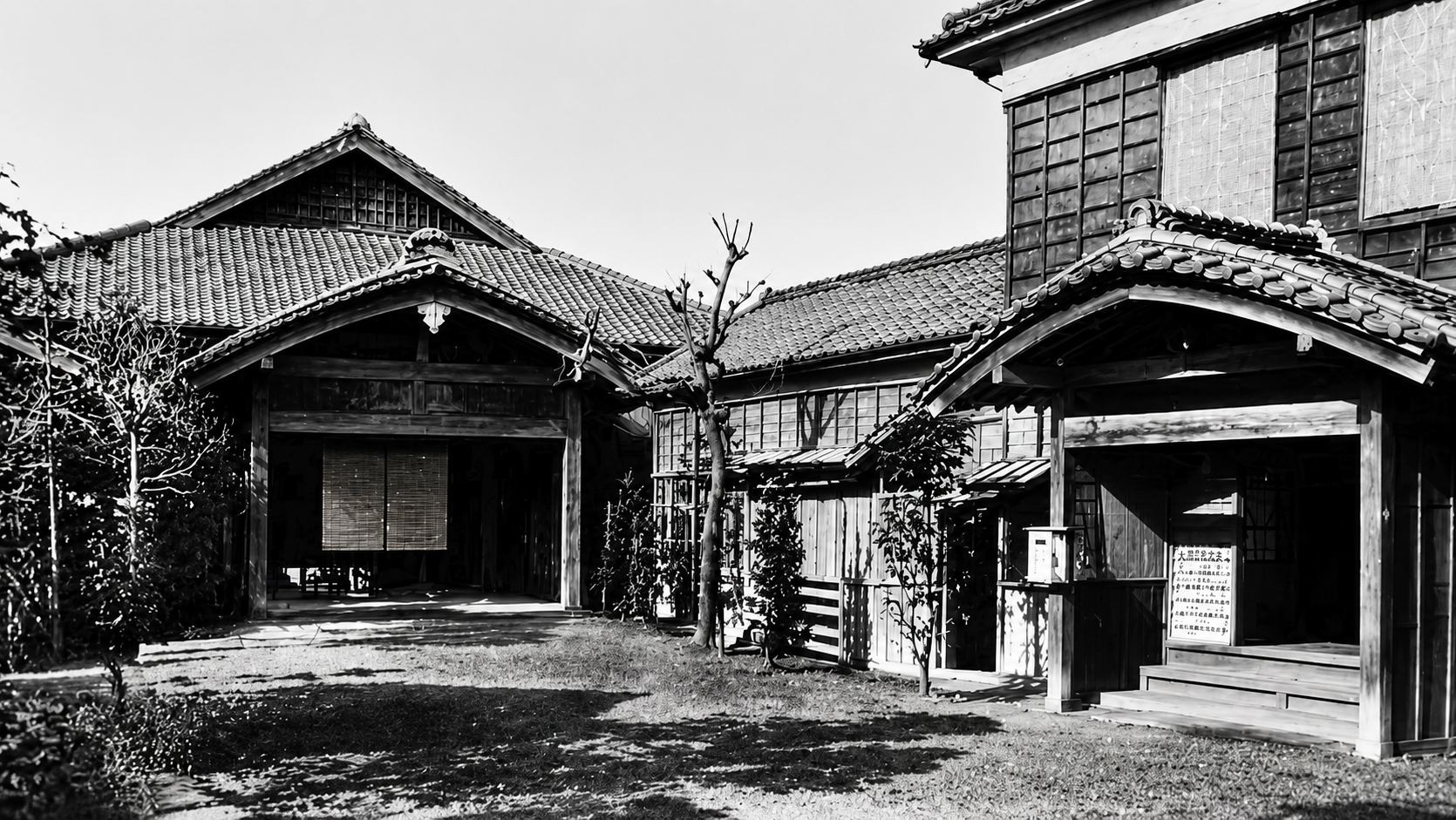
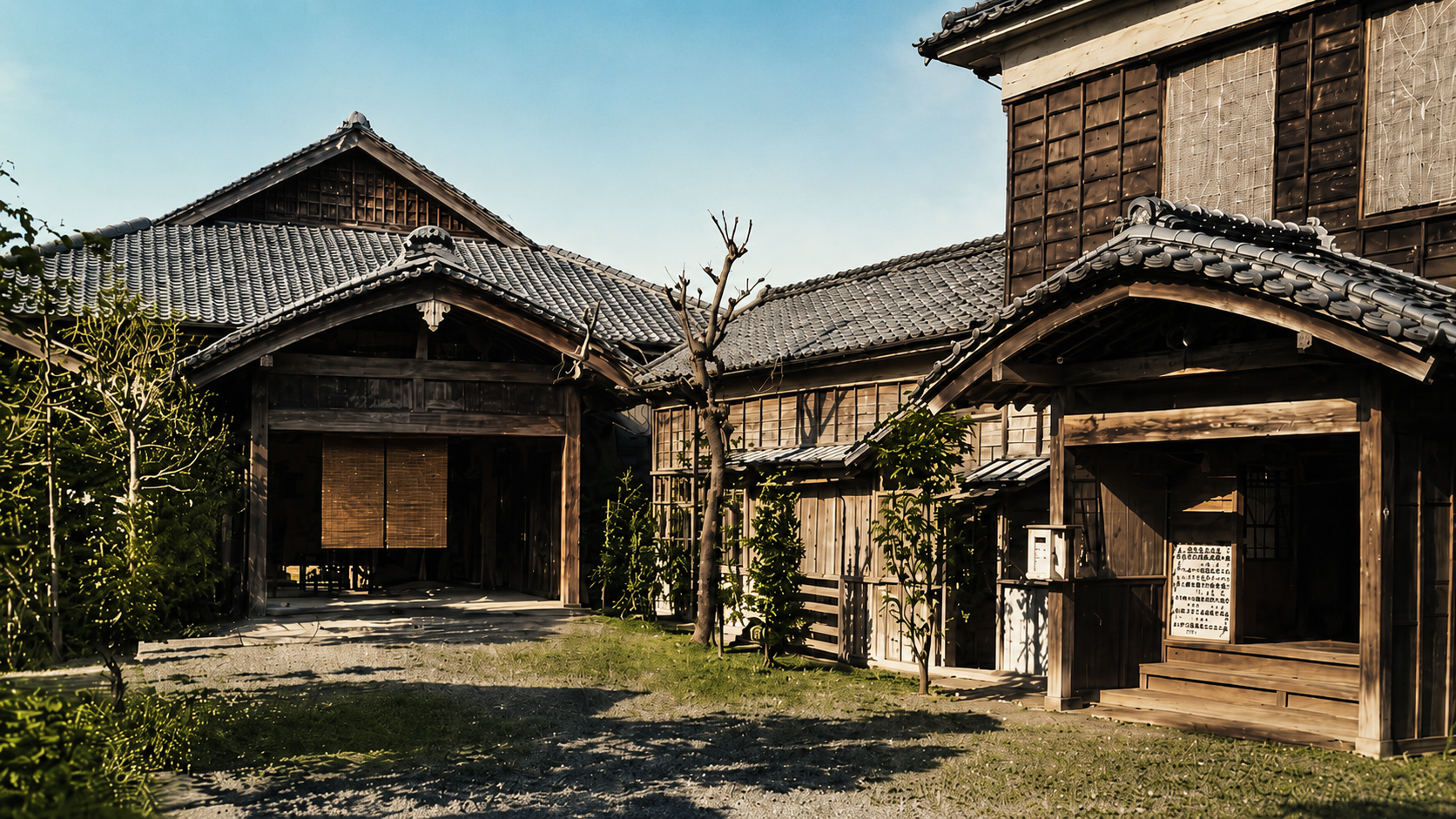
- The first Kōdōkan, founded in 1882 within the Eishōji Temple, was a small dōjō of twelve tatami mats. The buildings from that period were destroyed in the fires that followed the Great Kantō Earthquake of 1923. The temple still exists today, rebuilt, and preserves a monument marking the birthplace of the Kōdōkan.
- The Kōdōkan that Funakoshi knew in 1922 was the Shimotomisaka dōjō, in Koishikawa. It operated between 1894 and 1933 (the building later disappeared in the bombings of 1945, just as the Shōtōkan dōjō did) and became one of the largest training centers in Japan. That building no longer exists, and the area was later transformed. It is very likely that the photograph above shows the dōjō that Funakoshi knew and visited, although it could also depict another jūdō dōjō. In any case, it should not be confused with the Shōtōkan dōjō. What can be stated with confidence is that the image shows a jūdō dōjō, and most probably the Shimotomisaka dōjō.
- The current Kōdōkan is located in Kasuga, in Tokyo’s Bunkyō ward. It is a modern multi-story complex dedicated to training, research, as well as the library and museum of jūdō.
Note: In addition, the color version is an AI-generated recreation. The colors, textures, and some small details were interpreted, so it should not be presented as an exact documentary colorization.
What Was It Created For?
Kanō believed that the old martial schools contained valuable knowledge, but he also thought that this knowledge needed to be organized and adapted so that it could be practised systematically and with a reasonable degree of safety.
Training at the Kōdōkan combined two fundamental methods. Kata preserved principles and techniques through predetermined sequences. Randori, by contrast, allowed practitioners to experiment freely against a partner who also offered resistance. To make this kind of practice possible, it was necessary to restrict certain techniques, or reserve for kata those that could cause serious injury.
The ultimate purpose went far beyond defeating an opponent. Kanō summarized his philosophy through two major principles:
- Seiryoku zen’yō — the most effective use of physical and mental energy.
- Jita kyōei — mutual welfare and prosperity.
According to Kanō’s own teaching, what was learned through kata and randori should be applied to everyday life. Jūdō could serve as self-defence, physical education, and mental discipline, but also as a guide for interacting with others and contributing to the progress of the community.
From a Small Training Hall to a National Institution
The growth of the Kōdōkan forced it to relocate several times. Its different headquarters were established in places such as Fujimi-chō, Shimotomisaka, and Suidobashi, before it eventually moved into its present building in Kasuga, in Tokyo’s Bunkyō ward.
Each relocation reflected the increasing number of students and the growing influence of jūdō. What had begun in a room inside a temple gradually became an institution with training halls, teaching departments, archives, a library, a museum, and an international grading system.
Kanō was not only the founder of jūdō. He was also an important educator, the principal of the Tokyo Higher Normal School, a promoter of modern physical education, and, from 1909, the first Asian member of the International Olympic Committee. The expansion of the Kōdōkan was closely connected to this educational and international vision.
The Challenges Against the Traditional Schools of Jūjutsu
The consolidation of the Kōdōkan was not immediate. During its early years, its practitioners took part in matches and challenges against representatives of traditional jūjutsu schools. The favourable results achieved by students such as Shirō Saigō, Tsunejirō Tomita, Yoshitsugu Yamashita, and Sakujiro Yokoyama helped strengthen the reputation of the new system.
However, an important historical clarification is necessary. Many popular accounts describe a single police tournament held in 1886, in which the Kōdōkan is said to have achieved thirteen victories and two draws. More recent research suggests that several encounters probably took place between 1885 and 1888, and that the surviving records are incomplete. It is therefore more accurate to state that Kōdōkan representatives achieved favourable results against various schools of jūjutsu, without treating any specific score as an unquestionable historical fact.
These encounters were important, but they do not by themselves explain the success of jūdō. Its expansion was also due to Kanō’s ability to organize instruction, train teachers, introduce jūdō into educational institutions, and present its practice as a modern system of education.
A Place of Research and Exchange
The Kōdōkan was not merely the administrative centre of jūdō. It also became a place for research into the martial arts.
Kanō showed an interest in combat systems other than his own. He studied Western boxing, observed other disciplines, and welcomed practitioners from different traditions. Documents even show that he had already come into contact with representatives of Okinawan karate before meeting Funakoshi in person.
In April 1911, for example, a group of young Okinawan instructors visited Kanō. They spoke with him about jūdō and karate, practised joint-locking techniques, and gave a board-breaking demonstration. This episode shows that Kanō’s interest in the Okinawan art did not suddenly begin in 1922.
The Arrival of Gichin Funakoshi
In 1922, Gichin Funakoshi travelled from Okinawa to Tokyo to take part in a physical education exhibition promoted by the Ministry of Education. His presentation of Tōde attracted public attention, and particularly that of Jigorō Kanō.
Shortly afterwards, Kanō invited him to give a demonstration at the Kōdōkan before a large audience of jūdō practitioners. Funakoshi asked for the assistance of Shinkin Gima, a young Okinawan who was studying in Tokyo and who also had experience in jūdō.
According to the Japan Karate Association, the audience filled the dōjō and the demonstration was received with great interest. Later accounts state that Funakoshi performed the kata Kūsankū—later known in Shotokan as Kankū—while Gima presented Naihanchi. They also demonstrated applications and answered questions from Kanō and his students.
That encounter should not be interpreted as a simple exhibition intended to entertain the judoka. Funakoshi was presenting, before one of Japan’s most prestigious martial institutions, an art that was still largely regarded as a regional practice from Okinawa.
Kanō, for his part, did not merely observe the demonstration out of courtesy. Gima’s testimony recalls his enthusiasm, his questions, and his interest in understanding how karate techniques worked. An academic study on Kanō’s relationship with other forms of combat also emphasizes the importance of the support he gave Funakoshi during those early years.
The Encounter That Helped Change the History of Karate
The visit to the Kōdōkan was not karate’s first appearance on the main islands of Japan, nor did it by itself transform Funakoshi into the founder of a new discipline. Nevertheless, it represented a decisive moment.
The approval of a figure as respected as Jigorō Kanō gave Funakoshi a degree of legitimacy that would have been difficult for a virtually unknown Okinawan master to obtain in Tokyo. The success of the demonstration led to further invitations and encouraged many people to ask him to remain in the capital.
Funakoshi had originally intended to return to Okinawa after fulfilling his commitment at the exhibition. Instead, he began teaching at the Meiseijuku, a residence for Okinawan students, and published his first book on the art that same year. During the years that followed, karate began to spread through Japanese universities and to adopt an educational structure that was more readily understood by the society of mainland Japan.
The Kōdōkan did not create Funakoshi’s karate, but it offered him something essential: a place from which it could be observed, evaluated, and recognized by representatives of Japanese budō.
The Legacy of the Kōdōkan
Over the decades, the Kōdōkan became the international centre of jūdō. From there, its kata were studied and preserved, instructors were trained, and the grades of practitioners from numerous countries were officially registered.
In 1964, jūdō was included in the Olympic programme during the Tokyo Games. By then, the small school founded by Kanō in 1882 had given rise to a discipline practised throughout the world. Yet its deepest legacy does not lie in competition alone. The Kōdōkan continues to represent the idea that a martial practice can become a path of education, responsibility, and personal improvement.
This is also why Funakoshi’s visit was so significant. In that dōjō, two men from different traditions came together, united by the same conviction: that the martial arts should serve a purpose greater than simply defeating another person.
The Day Funakoshi Entered the Kōdōkan
Historical documents allow us to know the essential facts: Kanō’s invitation, the presence of Shinkin Gima, the kata that were performed, and the favourable reception of those in attendance. But documents cannot always convey the human weight of such a moment.
What might Funakoshi have felt as he entered the most prestigious martial institution in Tokyo? Was he aware that the demonstration could determine the future of karate in Japan? How might Kanō have regarded that Okinawan master presenting a system based on strikes, kicks, body movement, and kata that were unfamiliar to most of those present?
In my historical novel Walking Upright, I reconstruct that day through the eyes of Gichin Funakoshi: his arrival at the Kōdōkan, his meeting with Jigorō Kanō, the tension before the demonstration, and the moment when Okinawan karate was presented before some of the most influential figures in Japanese budō.
History tells us that Funakoshi entered as a guest. The novel attempts to show why he left as the bearer of a mission that would no longer allow him to return to the life he had left behind in Okinawa.
WALKING UPRIGHT — The Novel
In my novel, I recount the moment when Gichin Funakoshi prepares to give his demonstration at the Kōdōkan.
Walking Upright is the first novel in the trilogy of the same name.
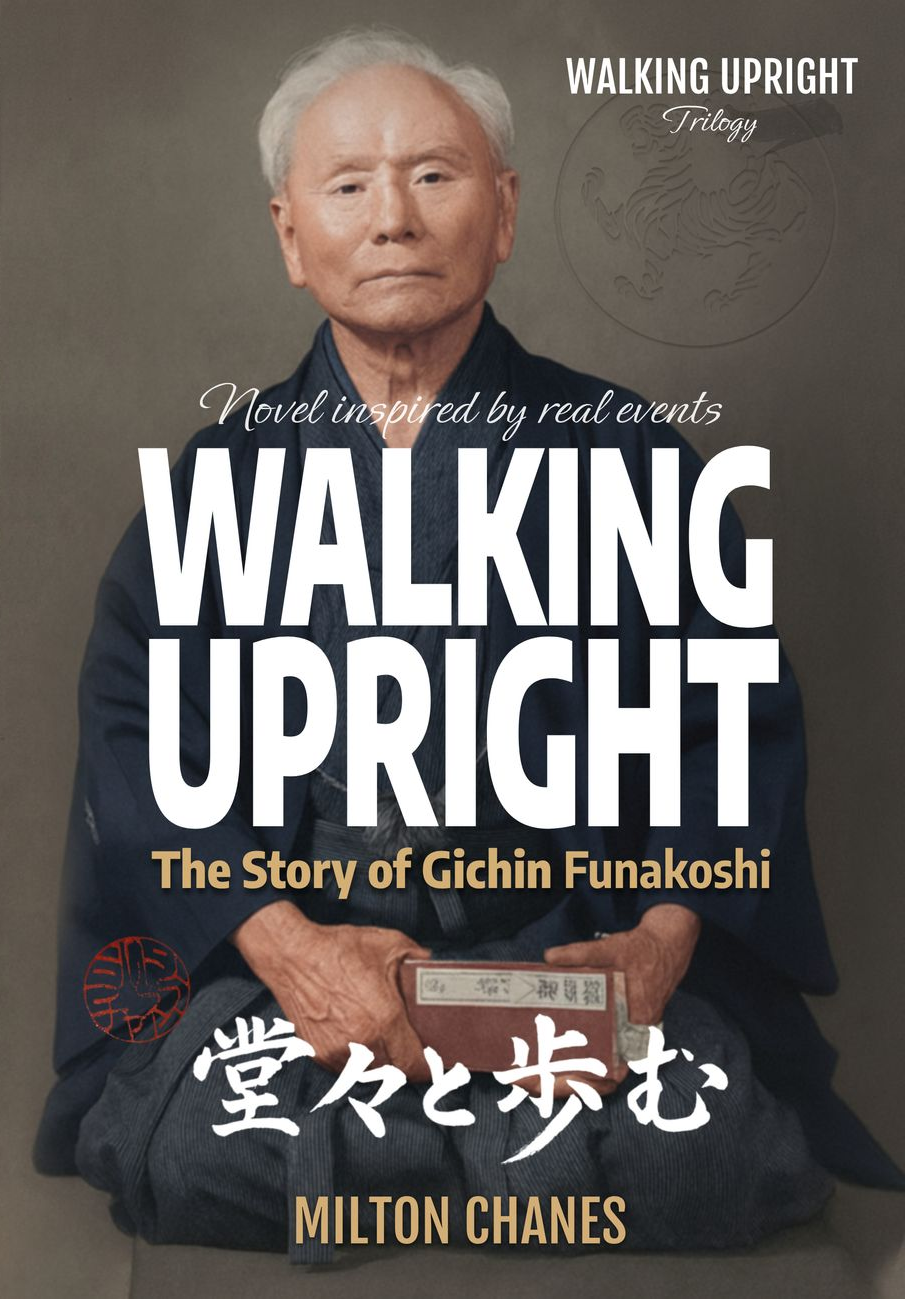
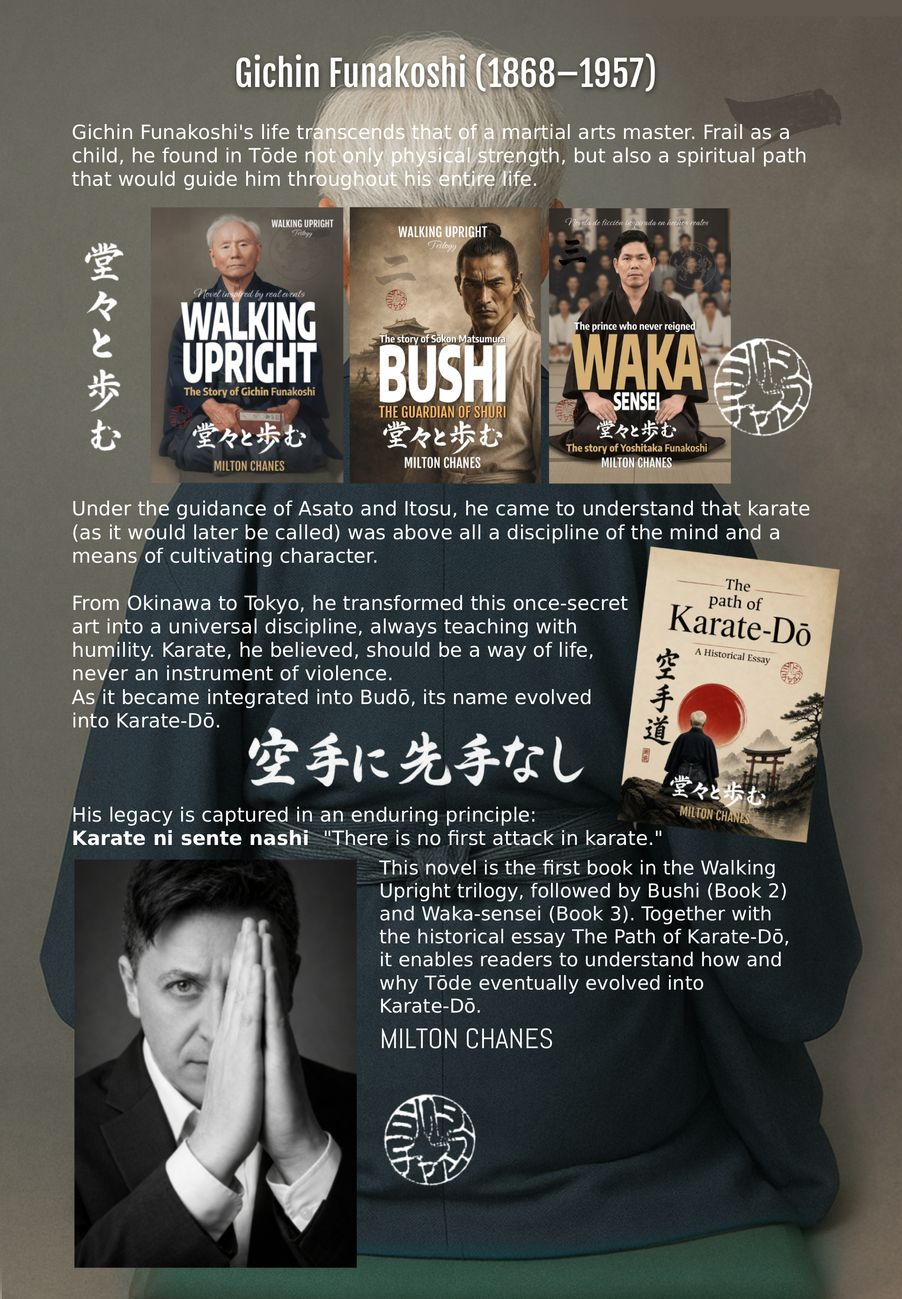
A NOVEL INSPIRED BY TRUE EVENTS · PUBLISHED
Walking Upright
Karate-Dō · The story of Gichin Funakoshi
A fictional novel inspired by real events. Not a manual of techniques but an essay in lived ethics: how the Okinawan path of karate-dō became a discipline for the body, the mind, and the way we move through the world. A meditation on lineage, dignity and the quiet decision to walk upright.
Walking Upright Trilogy - Book 1.
YEAR
2025
PAGES
+620
FORMATS
3
LANGUAGES
6
AVAILABLE IN
Recent Posts