Yoshitaka Funakoshi
Gigo Funakoshi: The Young Master Who Sustained Karate Through Its Most Difficult Years
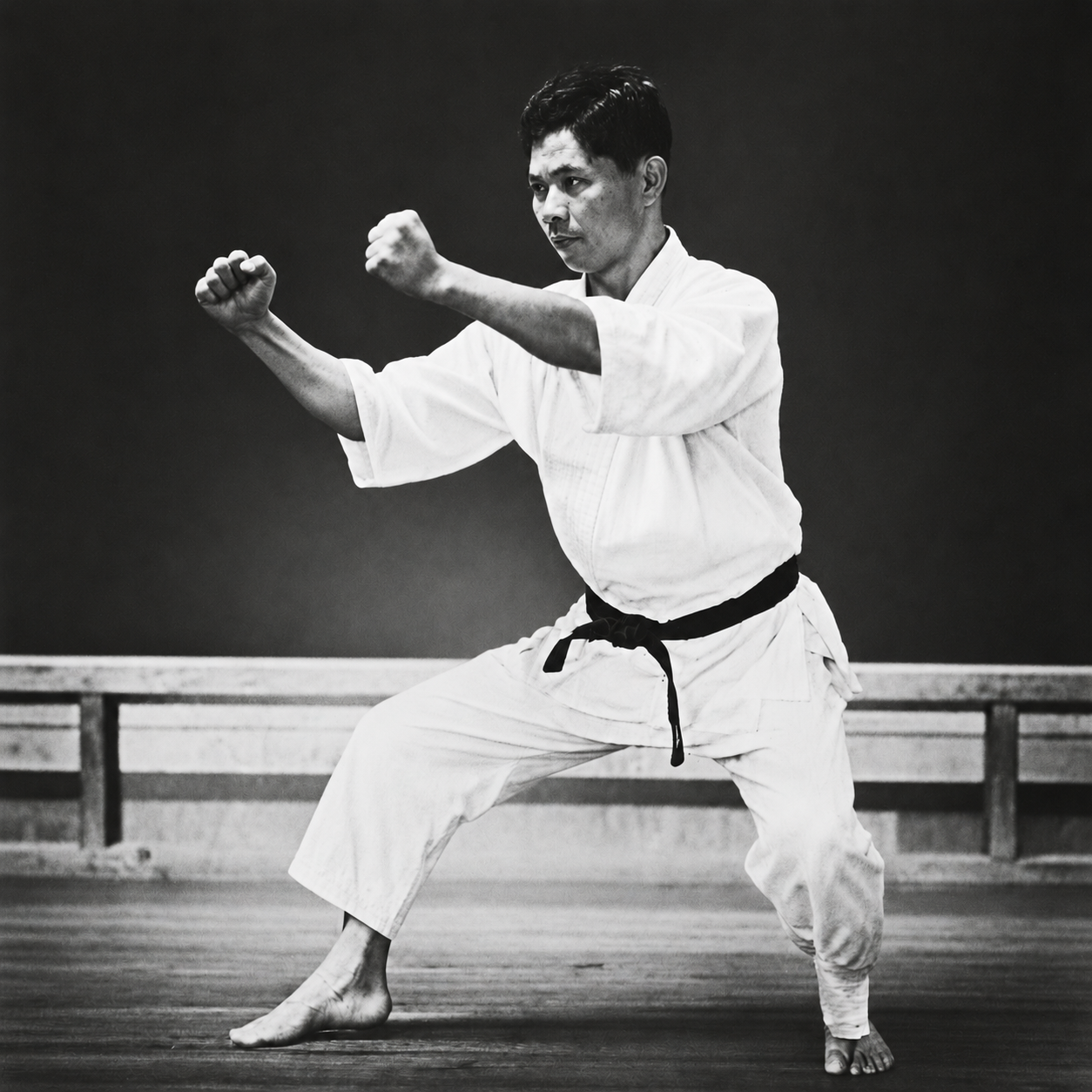
When the Funakoshi family is discussed, attention is usually focused almost entirely on Gichin Funakoshi, the Okinawan master who introduced karate to Japan and played a decisive role in its recognition within the world of budō. Yet beside him worked a much younger figure, marked by illness and by an extraordinarily short life: his son Yoshitaka Funakoshi, known within the family as Gigo and called Waka-sensei—the “young master”—by his students.
His story is not merely that of the son of a great master. It is the story of a man who became one of the greatest hopes for the karate of his time, even while knowing that his own body might fail him at any moment.
A Child Condemned by Illness
Gigo Funakoshi was born in 1906. When he was only seven years old, he was diagnosed with tuberculosis, an especially serious and difficult disease to treat during the early decades of the twentieth century.
Doctors reportedly believed that he would probably not live beyond the age of twenty.
Despite that prognosis, Gigo reached the age of thirty-nine.
The illness remained with him throughout his life. His adulthood, his professional work, and his practice of karate all developed under the constant awareness that his time might be limited.
It is impossible to know precisely how deeply this influenced his personality or his approach to training. Nevertheless, it is difficult to separate his development as a karateka from the disease that had accompanied him since childhood.
Gigo was not merely a sick man who practised karate. He became a respected technician, an instructor, and eventually the person in whom his father placed much of his hope for the future of his teaching.
Yoshitaka, Gigo, and Waka-sensei
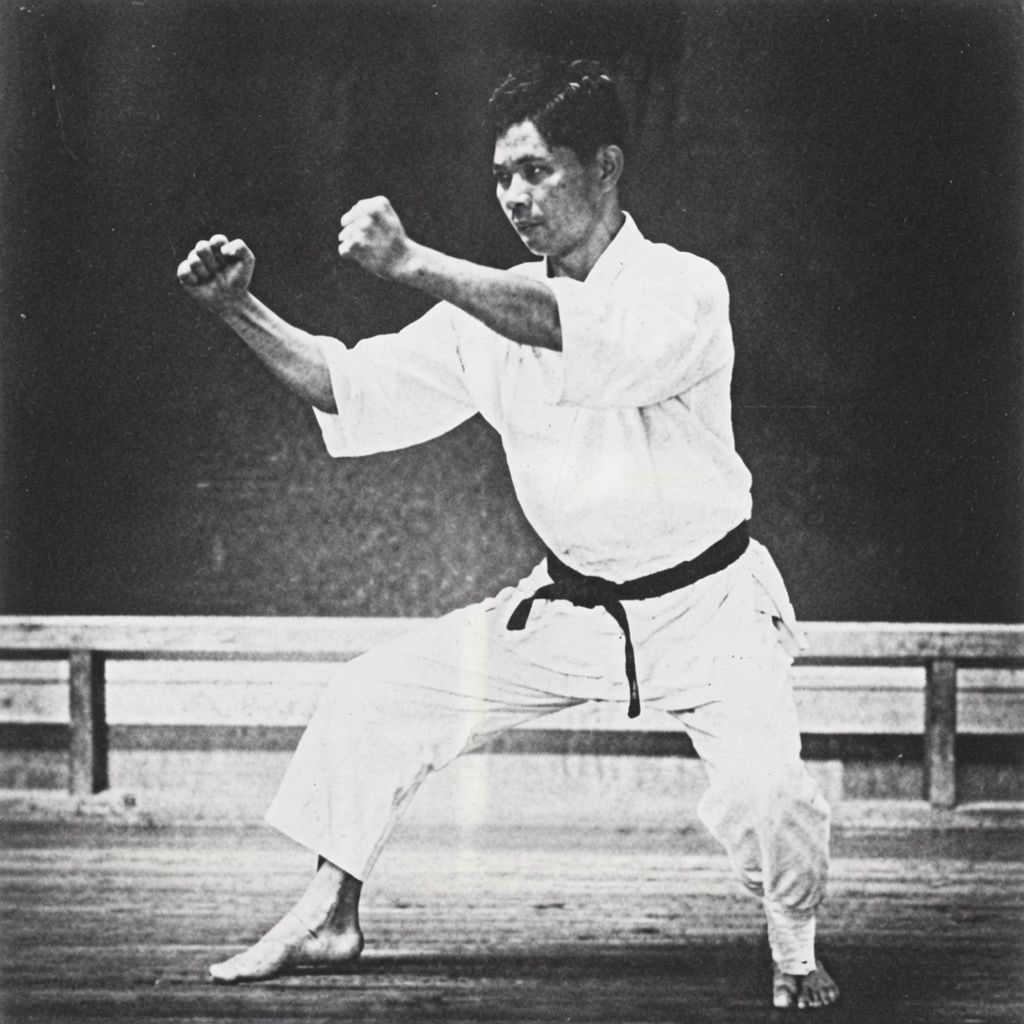
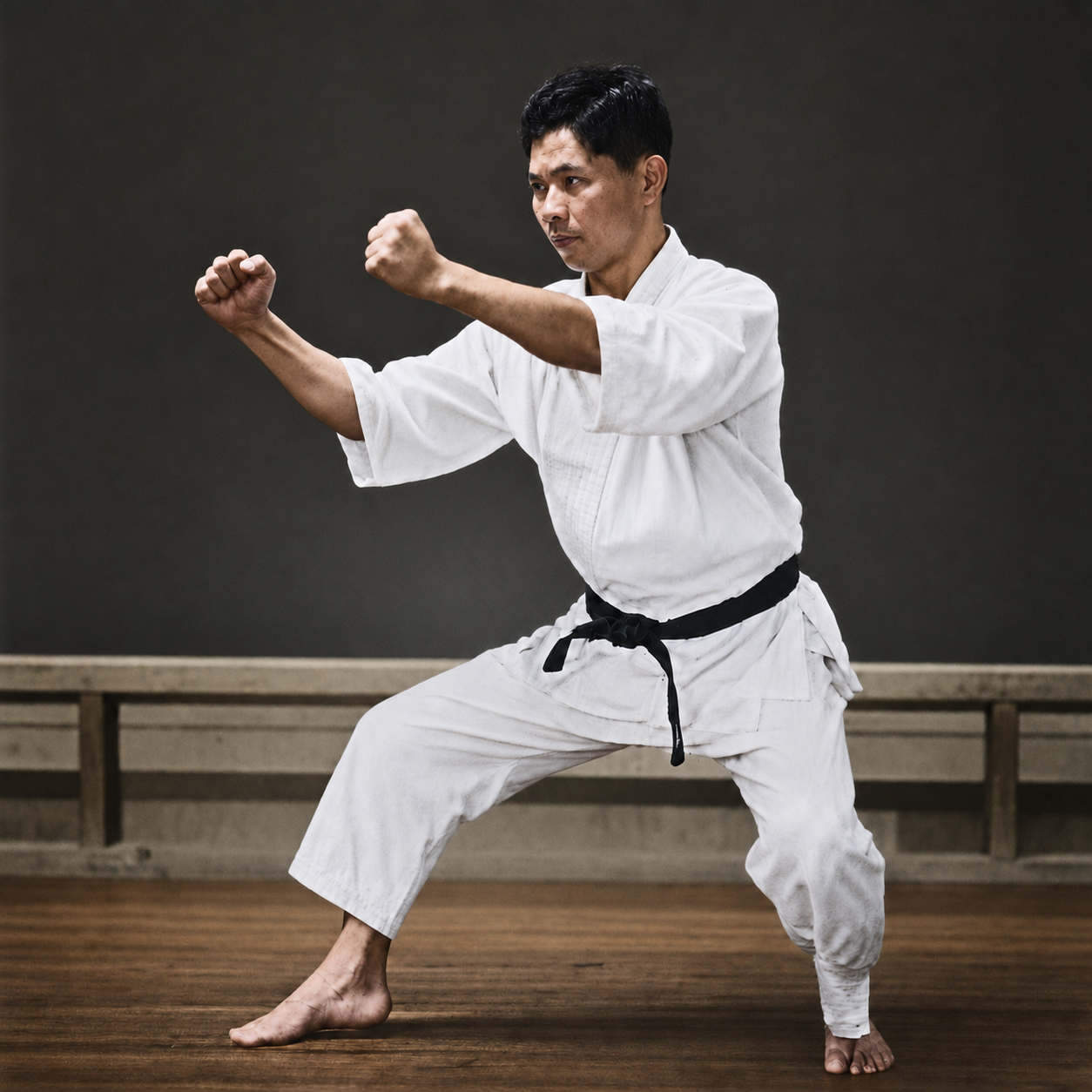
The name that appears in many historical documents is Yoshitaka Funakoshi, although within the family he was known as Gigo.
Among the students, however, he was commonly addressed as Waka-sensei, an expression that may be translated as “young master.”
The name distinguished him from his father, Gichin Funakoshi, whom the students referred to as Rō-sensei, the “senior master” or “old master”.
In this way, both men could be clearly identified within the same teaching environment. Gichin represented the experienced master, while Gigo embodied the younger generation that was gradually assuming greater responsibility.
This distinction was not merely a question of age. It also reflected the coexistence of two generations within the same project.
Gichin Funakoshi brought experience, authority, and an understanding of karate deeply connected to moral education and the cultivation of character. Gigo, on the other hand, belonged to a generation educated in Japan, closely connected to university students, and confronted by a society undergoing profound and rapid change.
Waka-sensei did not remain in his father’s shadow as a simple assistant. He had to establish his own position as an instructor among students who, in many cases, had also received direct instruction from Gichin.
Over time, his technical ability and growing responsibilities allowed him to become a recognisable figure in his own right.
Before the Shōtōkan Dōjō
When the word Shōtōkan is used in relation to this period, an important distinction must be made.
At that time, Shōtōkan was not yet the formal name of a clearly defined karate style. It was the name given to the dōjō built for Gichin Funakoshi and his students.
Gigo had already been assisting his father long before that dōjō officially existed.
During the early expansion of karate in Tokyo, much of the teaching took place in university clubs, student residences, borrowed halls, and other temporary locations. These university groups became essential to the growth of karate in mainland Japan.
They were not simply places where students gathered to train. They became centres of transmission, experimentation, organisation, and the formation of future instructors.
Gigo participated in this university environment for years. He helped his father teach students and gradually developed direct relationships with the younger practitioners who would later contribute to the expansion of the art.
Many of those university students and former students would eventually help gather the money, support, and organisational resources needed to build a permanent training hall.
The opening of the Shōtōkan dōjō therefore did not mark the beginning of Gigo’s teaching activity. It represented the physical consolidation of work that had already been taking place for years.
The Original Meaning of Shōtōkan
To understand the origin of the name Shōtōkan, it is necessary to look beyond the meaning it acquired after the Second World War.
Before the word became internationally associated with a particular tradition or school of karate, Shōtōkan was first and foremost a physical place.
The dōjō stood on the same property as Gichin Funakoshi’s home.
From the street, students entered through a narrow passage that ran alongside the house. They walked past the family residence before reaching the training hall situated farther inside the grounds.
This physical arrangement helps us understand the name from a more immediate and human perspective.
The students were not travelling to the headquarters of a karate style officially called Shōtōkan. They were going to the place where Gichin Funakoshi lived and taught.
Gichin used the literary name Shōtō when writing poetry and practising calligraphy. The word kan may refer to a building, hall, institution, or place of learning.
Shōtōkan could therefore be understood as “Shōtō’s hall” or, in a more familiar sense, “Shōtō’s house.”
When the students spoke of going to Shōtōkan, they were referring to the place associated with Shōtō: the property where their teacher lived and where they gathered to practise.
The name did not originally identify a formal system separated from other forms of karate. It first identified a place and, by extension, the community that trained there.
Only later—particularly after the war, as the students of Funakoshi organised themselves into different groups and karate expanded internationally—did Shōtōkan acquire the much broader meaning it carries today.
The Construction of the Dōjō
The precise chronology of the dōjō’s construction remains difficult to establish.
Its official inauguration took place in 1939, although the planning, fundraising, and work that made the building possible had begun earlier.
Some accounts suggest that the project may have developed over a considerably longer period. The year 1933 has occasionally been proposed as a possible starting point, but there is not yet enough publicly available documentation to present that date as definitively established.
It is therefore more prudent to say that the project and its construction began before the official inauguration, while recognising that the exact sequence of events still requires further documentary confirmation.
The inauguration should not necessarily be understood as the first occasion on which the property or parts of the developing structure were used for training.
It is possible that students gathered, practised, or used parts of the site while the project was still under construction. However, until stronger documentary evidence emerges, this should be presented as a reasoned historical reconstruction rather than an unquestionable fact.
What can be stated more confidently is that the dōjō did not suddenly appear in 1939 as the beginning of a new teaching project.
It was the result of many years of instruction in universities and temporary locations, the growth of the student community around Gichin Funakoshi, the increasing contribution of Gigo, and the collective desire to create a permanent home for their practice.
The name Shōtōkan was probably strengthened by several factors that gradually converged:
Gichin Funakoshi’s literary name, the physical relationship between his house and the dōjō, the everyday language used by the students, their respect for their teacher, and the later decision to place the name above the entrance.
Before becoming the international name of one of the world’s most widely practised karate traditions, Shōtōkan was something far simpler and more personal:
the place where students went to train with Shōtō.
His Father’s Principal Assistant
During the first years of karate’s expansion in Tokyo, one of Gichin Funakoshi’s most prominent students was Takeshi Shimoda.
Shimoda’s premature death in 1934 left an important absence within the group.
From that point onwards, Gigo gradually assumed the role of his father’s principal assistant and became one of the main pillars supporting his teaching.
This responsibility initially developed within the university clubs, several years before the official inauguration of the Shōtōkan dōjō.
Karate was still attempting to establish itself within the Japanese martial world and depended heavily on relatively small groups of practitioners connected to universities.
These clubs became essential centres for spreading the art and training new instructors.
For Gichin, his son came to represent much more than occasional assistance. Gigo was the man to whom he could entrust an increasing part of the teaching and, perhaps, the future continuation of his work.
By the time the Shōtōkan dōjō officially opened its doors in 1939, Gigo was neither an improvised instructor nor a recent addition to his father’s work.
He already possessed years of teaching experience and had developed a direct relationship with many of the students who had helped karate take root in Tokyo.
The relationship between father and son must have contained a painful contradiction.
Gichin watched his son grow as a disciple, technician, instructor, and possible successor. At the same time, he knew that Gigo had carried since childhood an illness that could take him away before he was able to complete his task.
A Life Beyond the Dōjō
Although karate occupied a central place in his life, Gigo also had a profession.
He worked as an X-ray technician for the Ministry of Health at the Imperial University.
The detail is particularly striking because of his own pulmonary illness. At a time when radiology was still developing as a medical field, Gigo worked with technology directly connected to the diagnosis of diseases similar to the one that had shaped his life since childhood.
He also possessed a strong interest in photography.
Some of the surviving images in which he appears alongside karateka such as Shigeru Egami and Genshin Hironishi were produced within his photographic environment.
Through these photographs, postures, gestures, and moments from pre-war karate have been preserved that might otherwise have disappeared.
Photography reveals another side of Gigo.
He was not only the man standing before students to teach them. He was also someone who observed, framed, recorded, and preserved images.
In that sense, he helped leave behind a visual testimony of the martial world to which he belonged.
A Respected Technician, but Not an Invincible One
Surviving descriptions present Gigo as a relatively small man, approximately 155 centimetres tall and weighing around 55 kilograms.
Despite his physical size and fragile health, he became recognised as a highly skilled technician.
Some testimonies suggest that he was not particularly interested in free fighting. This detail helps move his story away from the idealised images that are sometimes constructed around historical masters.
Gigo should not be imagined as an invincible warrior surrounded by extraordinary victories. He was a real practitioner, with personal preferences, abilities, weaknesses, and limitations.
One account also recalls a defeat during an exchange with Nei Chu So, a student of Gōgen Yamaguchi within the Gōjū tradition.
Rather than diminishing Gigo’s importance, such an episode helps humanise him.
His historical value does not depend on whether he won every confrontation. It rests on the position he achieved within the teaching, transmission, and development of karate during his generation.
Understanding historical masters as human beings allows us to appreciate their true achievements more clearly. They were people who learned, experimented, made mistakes, encountered difficulties, and continued practising. Gigo Funakoshi belonged to that reality.
The Destruction of the Shōtōkan Dōjō
The final months of Gigo’s life coincided with one of the most devastating periods in Japanese history.
The Shōtōkan dōjō, officially inaugurated in 1939 after years of teaching and preparation, was destroyed during the bombing of Tokyo in 1945.
It is worth repeating that, in this context, Shōtōkan was the name of the building and the training place created for Gichin Funakoshi and his students. It was not yet the formal name of a standardised karate style in the sense in which the word would later be understood.
The building had represented the physical realisation of decades of work by Gichin and his students.
Its destruction was not merely the loss of a training hall. It meant the disappearance of the symbolic home of a community that had previously spent years moving between universities, residences, and borrowed spaces.
After the destruction of the dōjō, training continued under extremely precarious conditions.
Some classes were reportedly moved to Takada Dai Hachi Elementary School, which had been closed after its pupils were evacuated to rural areas.
At times, no more than four practitioners attended these sessions.
Within this landscape of ruins, scarcity, and defeat, Gigo remained one of his father’s greatest hopes.
Yet his health was deteriorating rapidly.
The destruction of the Shōtōkan dōjō and the physical decline of Gigo occurred almost simultaneously.
For Gichin, the end of the war did not represent only the collapse of the country in which he had built his new life. It also meant watching the disappearance, one after another, of the building that represented his work and the son in whom he had placed much of his hope for its continuation.
The Death of the Young Master
During 1945, Gigo began to succumb to the illness that had followed him since childhood.
Some versions leave open the possibility that his final condition involved more than tuberculosis alone. Nevertheless, the surviving descriptions agree that his lungs were barely functioning when he was admitted to hospital.
Gigo expressed his wish to die at home.
He died in November 1945, only a few months after the end of the war, in the Ochiai area of the former Yodobashi district of Tokyo, at a place known as Green Court.
He was thirty-nine years old.
Family members and some of his closest students attended the funeral.
The conditions of the immediate post-war period made travel extremely difficult, particularly from Okinawa. As a result, many people connected to the Funakoshi family and to karate were unable to be present.
His death came only months after the destruction of the Shōtōkan dōjō.
For Gichin Funakoshi, the loss must have been profound.
He had lost his son, his principal assistant, and the man in whom he had placed his trust for the future of his teaching.
The Man Behind the Family Name
It is tempting to define Gigo simply as “the son of Gichin Funakoshi”. That description, however, is not enough.
He was a sick child who survived many years beyond the expectations of his doctors.
He was an X-ray technician, a photographer, a karateka, and an instructor.
He began assisting his father within the university clubs before the Shōtōkan dōjō officially existed, and he assumed increasingly important responsibilities after the death of Takeshi Shimoda.
When the dōjō was officially inaugurated in 1939, Gigo had already spent years working alongside his father and interacting with the university groups that had helped karate grow in Tokyo.
He was also a physically fragile man who accepted enormous responsibilities during a period marked by militarisation, war, bombing, deprivation, and destruction.
His life did not end at the moment of karate’s greatest expansion. It ended when almost everything around him appeared to be collapsing.
Perhaps that is one reason why his figure remains so powerful.
Gigo Funakoshi did not live long enough to become the elderly master whom generations of students could consult for decades.
He did not witness the international expansion that karate would experience after the war.
He was unable to help rebuild the dōjō that had carried his father’s literary name.
He died before seeing how far the art to which he had dedicated his final years would travel.
Yet during the brief time available to him, he ceased to be merely the son of a master.
For those who trained with him, he was Waka-sensei, the young master, while his father was Rō-sensei, the senior master.
They belonged to different generations, but they worked within the same undertaking.
Gigo became a distinct, recognisable, and essential figure within the generation that attempted to keep karate alive while the world they had known was collapsing around them.
Discover the History Behind the Story
The story of Gigo Funakoshi, the original Shōtōkan dōjō, and the transformation of Okinawan Tōde into modern Karate-Dō forms part of the historical world explored in my books.
The Walking Upright Trilogy follows three generations connected to the preservation, development, and transmission of the Okinawan martial tradition:
Walking Upright is a historical novel inspired by the life of Gichin Funakoshi and his journey from Okinawa to mainland Japan.
Bushi: The Guardian of Shuri explores the life and world of Matsumura Sōkon during the final decades of the Ryūkyū Kingdom.
Waka-sensei: The Prince Who Never Reigned is inspired by the brief but remarkable life of Gigo Funakoshi and the generation that attempted to sustain karate through war, illness, and destruction.
The trilogy is accompanied by The Path of Karate-Dō, a historical essay that examines the people, places, terminology, documents, and cultural transformations behind the novels.
Find the English Editions on Amazon
Walking Upright — The Story of Gichin Funakoshi
The Path of Karate-Dō: A Historical Essay
Milton Chanes — Amazon Author Page
Explore the Books on the Official Website
Bushi: The Guardian of Shuri — Book Two
Waka-sensei: The Prince Who Never Reigned — Book Three
On the official website, readers can discover the historical background of each book, read opening chapters, and access available PDF samples.
Recent Posts