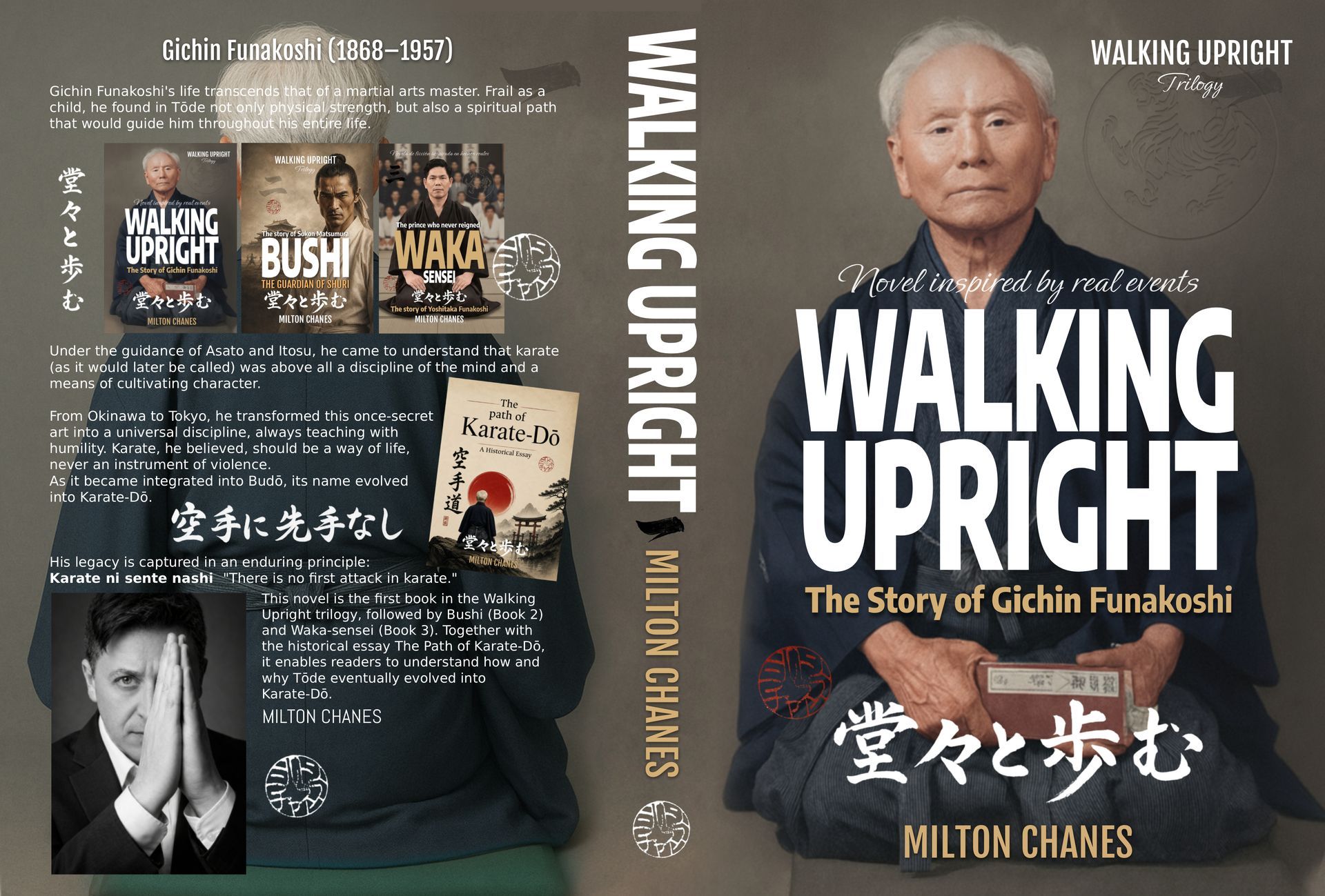
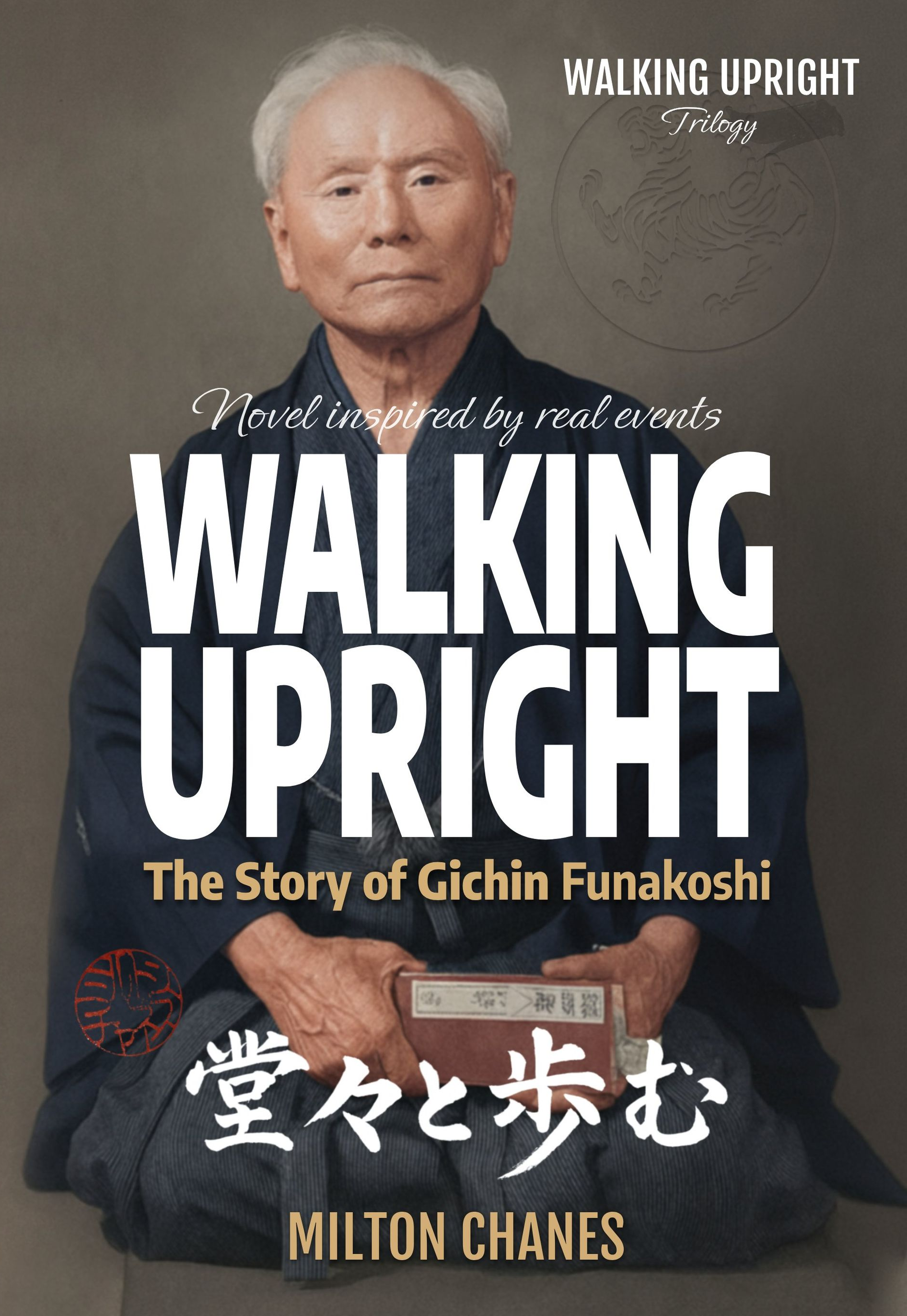
Walking Upright was born from that idea: to tell the story of a man who, long before becoming an essential figure in the spread of karate, was a frail child, a young man shaped by the traditions of Okinawa, and a teacher who found in the ancient art of Tōde much more than a method of self-defense. He found a way of life.
The novel is set in a time of profound change. Okinawa, once the heart of the Ryūkyū Kingdom, was caught between its own past and the growing influence of Japan. In that world, the art that would later be known as karate was still practiced discreetly, passed from master to student, far from the large dōjō, competitions, and modern image we know today.
Funakoshi grew up in that world. Under the guidance of masters such as Asato Ankō and Itosu Ankō, he came to understand that the value of the art lay not only in technique, but in the character it helped to shape. Training was not merely a sequence of strikes, blocks, and kata. It was an inner discipline. A way of learning to endure, to resist, to move forward, and ultimately, to stand tall. That is the heart of the novel.
Walking Upright is not intended to be only a story about karate. It is also a story about identity, humility, perseverance, and transmission. Through Funakoshi’s life, the reader is brought closer to an Okinawa where oral tradition, respect for teachers, and the cultivation of character formed part of a single vision of the world.
The novel follows Funakoshi from his early years to the moment when his destiny begins to change irreversibly. In 1922, he traveled to Tokyo at the invitation of the Japanese Ministry of Education to present the art of Okinawa at the First National Physical Education Exhibition. His intention was to return soon to his homeland, but that journey would mark a turning point. The insistence of figures such as Kanō Jigorō, Nakayama Hakudō, and Kosugi Hoan would lead him to remain in the Japanese capital and begin a task that would forever transform the history of martial arts.
But behind the recognized master there was always a quiet man. An Okinawan schoolteacher who taught with patience, who believed in courtesy, discipline, and personal improvement. A man who understood that karate should not be reduced to victory over another, but should become a path for shaping the human being.
That is why the title Walking Upright carries a symbolic meaning. It does not speak only of physical posture or bodily strength. It speaks of dignity. Of the ability to remain firm even when the world changes around us. Of walking with integrity, humility, and purpose.
The novel is part of a trilogy devoted to the great figures who helped shape modern karate. Walking Upright focuses on Gichin Funakoshi; Bushi explores the figure of Matsumura Sōkon; and Waka-sensei enters the life of Gigo Funakoshi, the master’s son and a fundamental figure in the technical evolution of Shōtōkan. Alongside them, the historical essay The Path of Karate-Dō offers a deeper understanding of how and why the ancient Tōde eventually evolved into Karate-Dō.
Writing Walking Upright was a way of looking back to the origin. Of trying to understand not only what happened, but what it meant. Because the karate we know today did not appear suddenly. It was the result of many lives, many decisions, and many sacrifices.
Among all of them, the life of Gichin Funakoshi holds a special place. His story reminds us that the true path does not always begin with strength. Sometimes it begins with fragility. With doubts. With a silent search. And, little by little, with the decision to rise and walk upright.