

Tode Ken Kyu Club
TODE Ken Kyu Club
When Okinawa’s great masters tried to build a shared Karate tradition
The history of Karate is often explained retrospectively through clearly differentiated styles, organizations, and lineages, as if the boundaries we know today had always existed. However, when we go back a hundred years, to Okinawa in the 1920s, we find a much less rigid reality, in which many masters knew one another, exchanged knowledge, and took part in common projects long before names such as Goju-ryu, Shito-ryu, or Shorin-ryu acquired the meaning they have today.
One of the most interesting examples from that period was the Tode Ken Kyu Club(although sources often refer to it as the
Karate Ken Kyu Club when translating the name into a more contemporary term), also mentioned in different sources as the Okinawa Karate Club or under names related to the term kenkyu, meaning study or research. The central information in this article is based on the work published by Sensei Salvador Herráiz, who reconstructed the history of the club, personally visited the site in Okinawa where it had once stood, and gathered information about its masters, students, facilities, and day-to-day operation. In his research, Herráiz presents the center as the first private dojo specifically dedicated to the study and teaching of Karate, and places the formation of the project around 1925, later bringing together figures such as Chojun Miyagi, Kenwa Mabuni, Chomo Hanashiro, and Choyu Motobu.
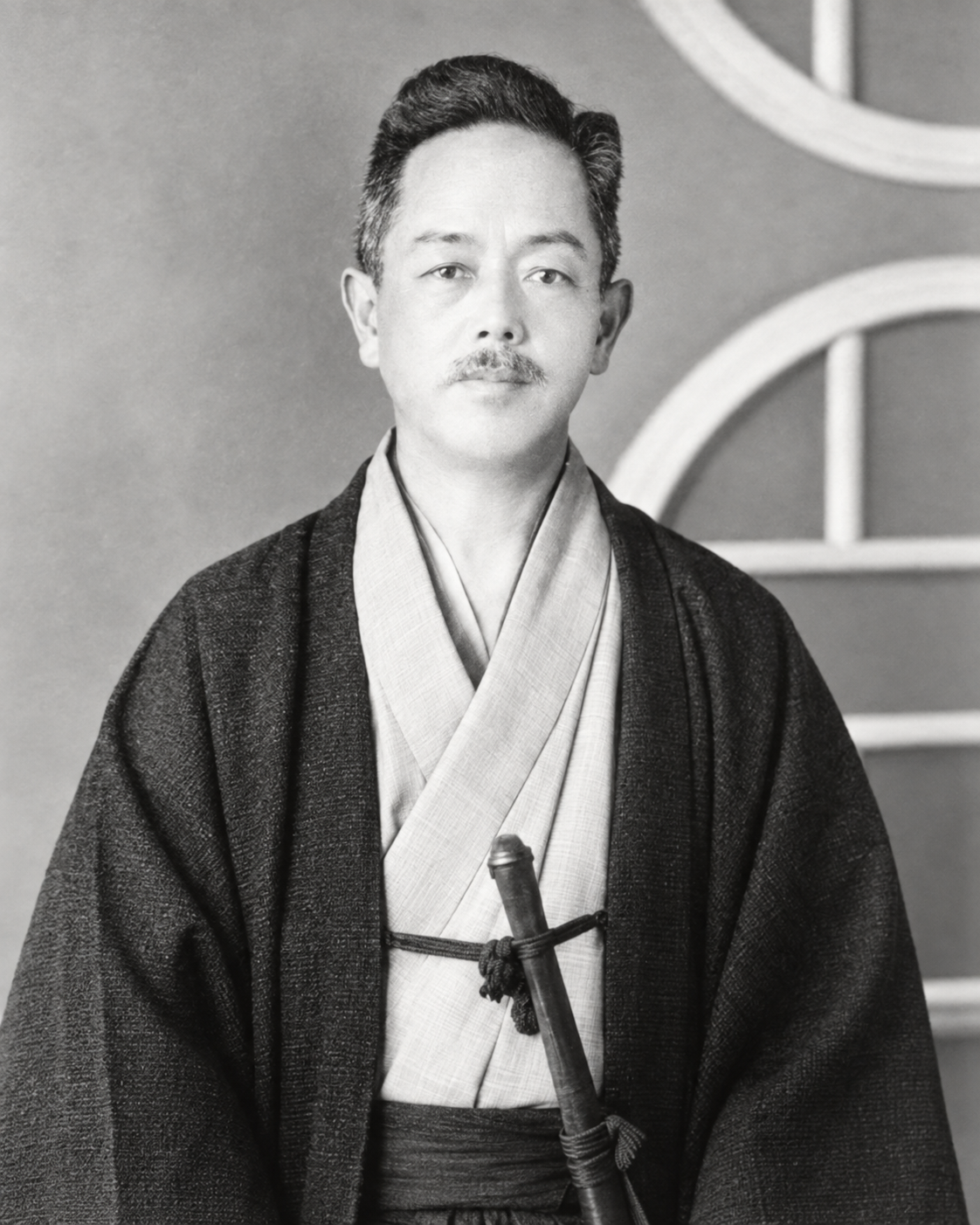
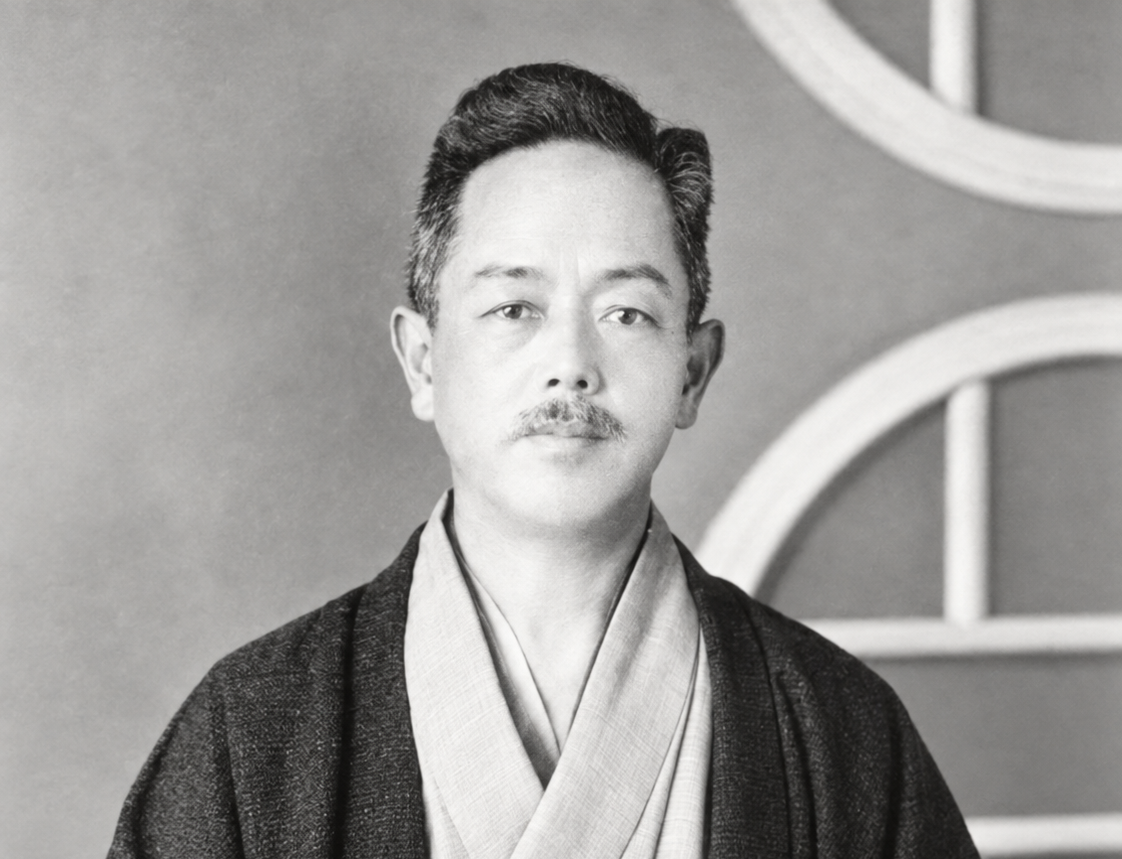
Master Kenwa Mabuni, founder of Shito-ryu.
Image quality enhanced with AI.
| Note on the club’s historical name: |
|---|
| In some modern texts, this organization is referred to as the Okinawa Karate Club or the Karate Ken Kyu Club, but it is worth bearing in mind that these names may modernize the original terminology too much. Japanese sources from the period use the form 沖縄唐手研究倶楽部, which can be transliterated as Okinawa Tōde Kenkyū Kurabu, meaning approximately “Okinawa Tōde Research Club.” The distinction is significant. At that time, it was still common to write the name of the art with the characters 唐手, associated with the idea of “Chinese hand,” and to pronounce it in Okinawa as Tōde or Tōdi. The modern spelling 空手, meaning “empty hand,” would only become widespread later. For this reason, simply using the word “Karate” when referring to the club may be convenient for the modern reader, but it does not fully reflect the terminology of the period. It is also important to note that the word “Okinawa” formed part of the historical names found in different sources, so it does not appear to have been a modern addition used merely to explain the club’s geographical origin. At a time when Tōde was beginning to become more publicly organized and was increasingly reaching mainland Japan, including “Okinawa” in the name may have helped identify the sphere and tradition represented by the organization. For the sake of clarity, in this article we use the name Okinawa Tōde Kenkyū Club when referring to the historical organization, while retaining Karate Ken Kyu Club when referring directly to the article by Sensei Salvador Herráiz, since that is the form used in his research. |
The existence of this collaboration is also supported by institutional documentation from Okinawa. The Okinawa Karate Information Center, an organization based at the Okinawa Karate Kaikan, identifies Miyagi Chojun and Mabuni Kenwa as leading figures of the Okinawa Karate Club in 1927, when they organized a demonstration to mark the visit to Okinawa of Kano Jigoro, founder of Kodokan Judo. Hanashiro Chomo, Kyan Chotoku, and other prominent karate practitioners of the period also took part in that demonstration.
This detail is particularly interesting because it helps us understand that we are still looking at a period before many of the styles familiar today had become firmly established. The same official Okinawan source explains that the terms Shuri-te, Naha-te, and Tomari-te began to appear in documented use in 1927, precisely in connection with that demonstration, and notes that most of the ryuha known today were established later.
For that reason, interpreting the
Ken Kyu Club simply as an association made up of representatives of several modern “styles” can be misleading. These men came from different technical lineages, but the boundaries between them had not yet acquired the institutional rigidity they would develop in later decades. Miyagi would not adopt the name
Goju-ryu until the beginning of the following decade, while Mabuni would later develop the system known as
Shito-ryu. The
Okinawa Karate Information Center places the emergence of many of these names in the years that followed and explains that the term
Goju-ryu arose after Jinan Shinzato was asked in Tokyo, in 1930, what school he belonged to.
A Project That Aimed to Be More Than Just a Place to Train
According to Salvador Herráiz’s research, those behind the club intended to preserve and develop Karate until it could achieve a level of organization within Japanese society comparable to that already enjoyed by disciplines such as Judo or Kendo. The center was therefore not meant to serve merely as a place for physical training, but as a space where different specialists could share methods, study techniques, and contribute to giving greater structure to an art that was still undergoing a significant transformation.
The later evolution of Karate itself confirms that this need for organization was already present during those years. By 1927, the Okinawa Karate Club had gained enough recognition to take responsibility for preparing the demonstration held during the visit of Kano Jigoro, an event of particular significance considering the influence that the founder of Judo exercised within the wider world of Japanese budo.
It is equally noteworthy that Okinawa’s present-day policy for preserving Karate still reflects, almost a century later, some of those same ideas. Among its institutional objectives, the
Okinawa Karate Kaikan emphasizes the transmission of the essence of Karate, the training of instructors and successors, and exchange between different styles both within and outside Okinawa. Allowing, of course, for the very different historical context, these principles echo the spirit of cooperation that lay behind those early organizations.
Miyagi, Mabuni, Hanashiro, and Motobu Under One Roof
Herráiz identifies Chomo Hanashiro, Kenwa Mabuni, Chojun Miyagi, and Choyu Motobu as central figures in the Karate Ken Kyu Club, noting that Miyagi served as chief instructor and director, while Motobu was also involved in the administration of the center.
From a modern perspective, the combination is remarkable. Hanashiro was directly connected to the tradition of Anko Itosu; Mabuni had studied under both Itosu and Kanryo Higaonna; Miyagi was developing the line he had received from Higaonna, while Choyu Motobu represented a martial tradition associated with his own family. Rather than appearing in separate chapters of today’s history books, these men could, during those years, be found participating in the same shared project.
That coexistence becomes even more significant when we remember that Naha, Shuri, and Tomari are precisely the major historical environments associated with the development of Okinawan Karate. The Naha City Assembly itself officially recognizes Naha as the “birthplace of traditional Okinawan Karate” and notes that Naha-te, Shuri-te, and Tomari-te developed within the territory of what is now the modern city.
For that reason, the Karate Ken Kyu Club should not be regarded merely as a historical curiosity or as a dojo that happened to bring together several famous masters for a few years. Its importance lies in the fact that it reflects a period before the institutional fragmentation of Karate, when some of its leading figures still appeared to consider it possible to study, preserve, and develop the art within a shared space.
Perhaps that is precisely why, a century later, the project remains so compelling. Before becoming founders, representatives of styles, or figures placed on separate branches of genealogical charts, these men were karateka who shared the same place and, for a brief period, attempted to build part of Karate’s future together.
Sources
- Main source for this article: Salvador Herráiz, Karate Ken Kyu Club, the historical article used as the basis for reconstructing the club, its members, facilities, and operation.
- Supporting institutional sources: Okinawa Karate Information Center, Okinawa Karate and Kobudo, particularly the documentation relating to the Okinawa Karate Club and the 1927 demonstration.
- Naha City Assembly: Declaration of the City of Karate and Kobudo.
- Okinawa Karate Kaikan: institutional information and the center’s stated objectives.
Recent Posts