The Company of the Future, Humans, Data and AI Agents Working Together
The Company of the Future, Humans, Data and AI Agents Working Together
Conversations about artificial intelligence in business often begin with tools, which model to use, which platform to adopt or which processes to automate. Yet there is a more important question that comes first. What problem are we trying to solve?
The adoption of AI in business does not really begin with ChatGPT, AI agents or large language models. It begins with data, processes and the knowledge an organisation has about the way it actually works. Without those foundations, even the most advanced technology can become an expensive solution to a poorly defined problem.
Good AI requires good data
Companies have spent decades accumulating information from customers, invoices, products, websites, applications and internal systems. Having large amounts of data, however, does not necessarily mean having useful information. Records may be duplicated, incomplete or outdated, and the same concept can mean different things to different departments.
This is where data governance becomes essential. It means defining what information represents, who is responsible for it, when it should be updated, what level of quality it should maintain and what should happen when something goes wrong. The purpose is not simply to store information but to ensure that it can be trusted when decisions need to be made.
This becomes even more important with artificial intelligence because predictive models, generative systems and AI agents depend directly on the information they receive. Poor data can lead to poor conclusions, which is why data governance and AI governance are increasingly becoming parts of the same business challenge.
Start with the use case, not the technology
One of the most common mistakes is to acquire a technology first and then search for somewhere to use it. The process should work in the opposite direction by identifying a need, a bottleneck, a repetitive task or a decision that could be improved before deciding which data and technologies are required.
That is essentially what a use case is.
A company may want to identify which customers are most likely to buy a product, estimate future revenue, detect potential fraud, review documents or analyse financial information automatically. Each objective requires different data, different models and different levels of supervision, which means that an AI strategy cannot really be separated from the broader business strategy.
Not every problem requires artificial intelligence either. When a task can be solved through clear and deterministic rules, conventional software may be simpler, cheaper and more reliable. AI becomes especially valuable when uncertainty, prediction, large volumes of information or relationships that are difficult to express through traditional rules become part of the problem.
From answering questions to taking action
Generative AI added the ability to interpret information and produce understandable responses, but agents are introducing a much more significant change because they can participate directly in business processes.
A system could access company information, analyse financial statements, detect anomalies and suggest improvements. With the appropriate permissions, it could even perform certain actions. This means moving beyond AI systems that simply provide answers towards systems that can actually operate inside an organisation. The greater the autonomy of the system, the greater the need to control its permissions, access and decisions.
The knowledge that was never written down
The arrival of these systems is exposing another long-standing problem inside companies. Much of their most valuable knowledge has never been formally documented because it exists in the experience of their employees.
A professional may know how to deal with an exception because they have encountered similar cases for fifteen years. A manager may understand every small step required to organise a process even though those steps have never appeared in a manual. As long as that knowledge exists only in people's minds, transferring it to artificial intelligence will remain difficult. Procedures, criteria, examples and exceptions are therefore becoming increasingly valuable. Turning them into structured documentation provides AI models with the context they need to understand how a particular organisation actually operates. This knowledge can also be divided into reusable units that models and agents can consult depending on the task they need to perform.
This leads to an important conclusion. An organisation's ability to automate will depend significantly on its ability to explain how it works. Before many processes can be automated, companies may first need to invest considerable effort in understanding and documenting them.
Companies made of people and agents
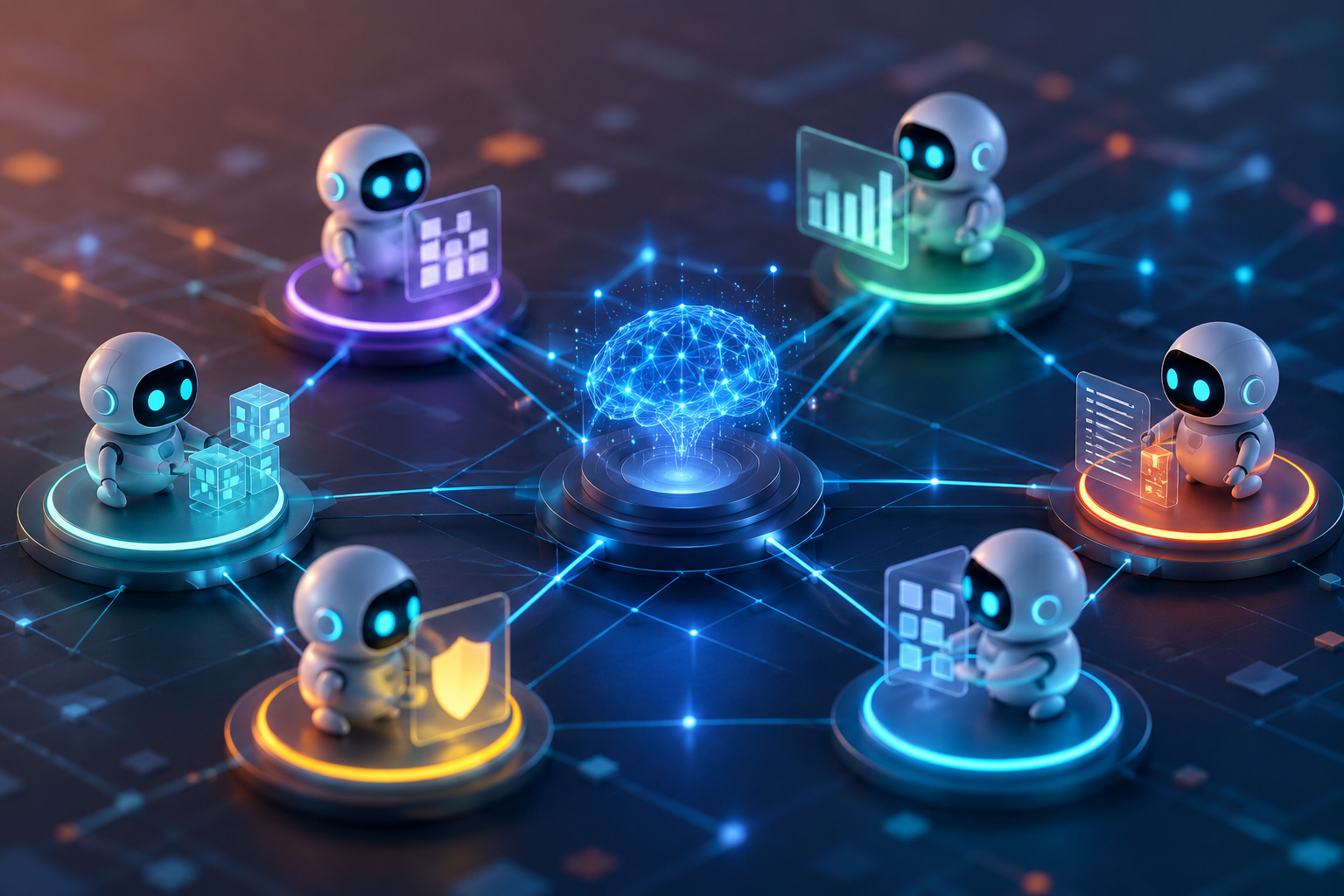
During the first stage of generative AI, the typical interaction involved opening a window and asking a question. The next stage will involve integrating specialised systems directly into everyday workflows. An organisation could have agents dedicated to planning, accounting, human resources, training, scheduling or financial analysis, with several agents working together to complete more complex processes.
This does not necessarily mean eliminating the human professionals associated with those roles. What is beginning to emerge instead is the idea of hybrid organisations, where digital systems collect information, prepare analyses, identify anomalies and perform certain tasks while people retain responsibilities involving judgement, supervision and accountability. A manager may eventually be responsible not only for a team of people but also for a group of AI agents with different permissions and levels of autonomy.
Greater autonomy requires greater governance
There is a substantial difference between using AI to draft an email and allowing an agent to access databases, consult confidential information or execute processes inside a company. As the ability of a system to act increases, the mechanisms controlling it must become stronger as well.
Identity, permissions, traceability, cybersecurity, data protection, human oversight and risk management therefore become part of the architecture itself. Organisations need to know what each agent can do, which information it can access, when it requires approval and who remains responsible for the decisions being made.
In some situations, an agent may operate autonomously until it reaches a predefined limit. Once a decision exceeds that level of risk, the system should stop and request human intervention. This combination of automation and supervision is likely to become one of the foundations of AI governance.
Building internally or buying externally
The growth of AI agents also creates a new strategic decision. Companies will have to decide which systems they want to develop themselves and which capabilities they prefer to obtain from specialised providers.
Today's tools make it far easier to create applications and automations than it was only a few years ago, but building a prototype is very different from operating an enterprise system. Once an agent needs to serve an entire organisation, companies must address security, maintenance, integration, access control, monitoring, updates and recovery procedures.
A mixed model is likely to emerge. Businesses may build internally the systems connected to their most distinctive knowledge while obtaining other capabilities through specialised platforms offering agents that are already secure, governed and ready for integration.
The real transformation is organisational
The most significant change produced by business AI may not be replacing one application with another but transforming the structure of work itself. Some activities will become fully automated, others will be supported by intelligent systems, and some decisions will continue to require human knowledge and responsibility.
The question will therefore move beyond what artificial intelligence can do. It will become a question of organisational design. What do we want AI to be allowed to do, under which conditions, and who ultimately retains authority?
Using these systems effectively does not eliminate the need for human knowledge. Understanding the problem remains necessary in order to formulate the right objective, provide appropriate context and evaluate the result. Someone with no knowledge of a subject may receive an answer from an AI system, but they will have far greater difficulty recognising when that answer is wrong.
Artificial intelligence can greatly expand our ability to analyse, learn, program and create, but that same capability makes it even more important to understand what we actually want to achieve with it.
Beyond the Hybrid Company
Even more radical scenarios are beginning to emerge. If AI agents can analyse information, purchase services, execute processes, coordinate with one another, manage resources and make certain decisions, one question inevitably arises that until recently belonged almost entirely to science fiction. Could a company eventually exist that was created and managed primarily by artificial intelligence?
There are obvious legal obstacles today. Artificial intelligence does not have legal personality of its own and cannot assume responsibility in the same way as a person or a corporation. Yet that does not mean the debate will disappear. On the contrary, the greater the autonomy of these systems becomes, the harder it will be to avoid it.
The first question will be unavoidable. Who is responsible when something goes wrong?
Business history has already faced similar challenges when societies had to determine how far the personal liability of those involved in economic activity should extend. That evolution led to new legal structures, including limited liability companies. Artificial intelligence may one day force us to consider a comparable transformation and redefine where the responsibility of an organisation begins and ends when a substantial part of its decisions no longer comes directly from human beings.
But there are even more difficult questions.
If a company created and managed by artificial intelligence ever exists, who will receive its profits? Who will own the assets it generates? Who will hold the rights to an invention developed by its systems? Who will decide what happens to the accumulated capital if the organisation itself is capable of reinvesting it, purchasing services, acquiring technology and continuing to grow?
These questions may seem excessively speculative today, but they lead to another that is even more uncomfortable. If we eventually accept that artificial intelligence systems can manage private organisations under certain rules, why should the discussion be limited to companies?
Could there one day be local administrations in which a significant part of management is delegated to artificial intelligence systems? Could regional governments use agents to manage budgets, infrastructure, transport, energy or public services? Could even a country eventually entrust certain administrative functions to autonomous systems supervised by human institutions?
Of course, managing a company and governing a society are profoundly different challenges. A government does not simply manage resources. It also represents rights, interests, values, conflicts and political decisions that directly affect millions of people. Precisely for that reason, the emergence of systems capable of participating in such decisions will raise questions that are not merely technological, but also legal, economic, democratic and philosophical.
Perhaps we will never reach the point of having a fully autonomous company, let alone a public administration governed by machines. Perhaps we will discover that there are limits we are unwilling to cross. Or perhaps some societies will choose to experiment with models that today are difficult for us to imagine.
In the meantime, human companies will have to learn to coexist with intelligent systems at an increasingly deep level, discovering where they can expand our capabilities, which decisions we are willing to delegate and which ones we want to preserve.
The company of the future will probably consist, at least for a long period, of people and intelligent systems working together. But it is possible that this will prove to be only an intermediate stage in a much larger transformation.
Companies created by artificial intelligence? Capital managed by machines? Public administrations partially run by autonomous agents?
Utopia? Dystopia? Perhaps neither.
Time will tell.
My Books on These Topics on Amazon

Recent Posts