From ChatGPT to Digital Employees: Why AI Agents Could Change the Way We Work
From ChatGPT to Digital Employees
Why AI Agents Could Change the Way We Work
During the early years of generative artificial intelligence, we became accustomed to a relatively simple relationship with these tools. We opened an application, asked a question, and waited for an answer. We could ask it to draft an email, summarize a document, explain a concept, translate a text, or write a few lines of code, but we were still the ones controlling almost the entire process. We selected the file, copied the information, formulated the instruction, received the result, decided what to do with it, and finally carried out the corresponding action.
That model remains extraordinarily useful, but it represents only the first stage of what is happening. The next transformation involves moving from artificial intelligence systems that simply respond to systems capable of acting, using tools, consulting different sources of information, making certain decisions within established limits, and continuing to work until they achieve a goal. This is where one of the concepts likely to become increasingly important over the coming years appears: the AI agent.
At first, the difference may seem small. After all, both chatbots and agents use artificial intelligence models. However, from the perspective of how work is organized, the difference is enormous. When we use a chatbot, we remain the system coordinating every step. When we use an agent, we begin to delegate not only a response, but also part of the process required to achieve a result.
A Chatbot Responds, an Agent Acts
Let us imagine something as ordinary as managing email. We can ask an artificial intelligence system to draft a reply to a message we have just received. To do that, we find the email, copy its content, explain what we want to say, review the generated text, locate the recipient, and finally send the message. The AI has helped us and may have saved us a few minutes, but we are still controlling practically the entire sequence.
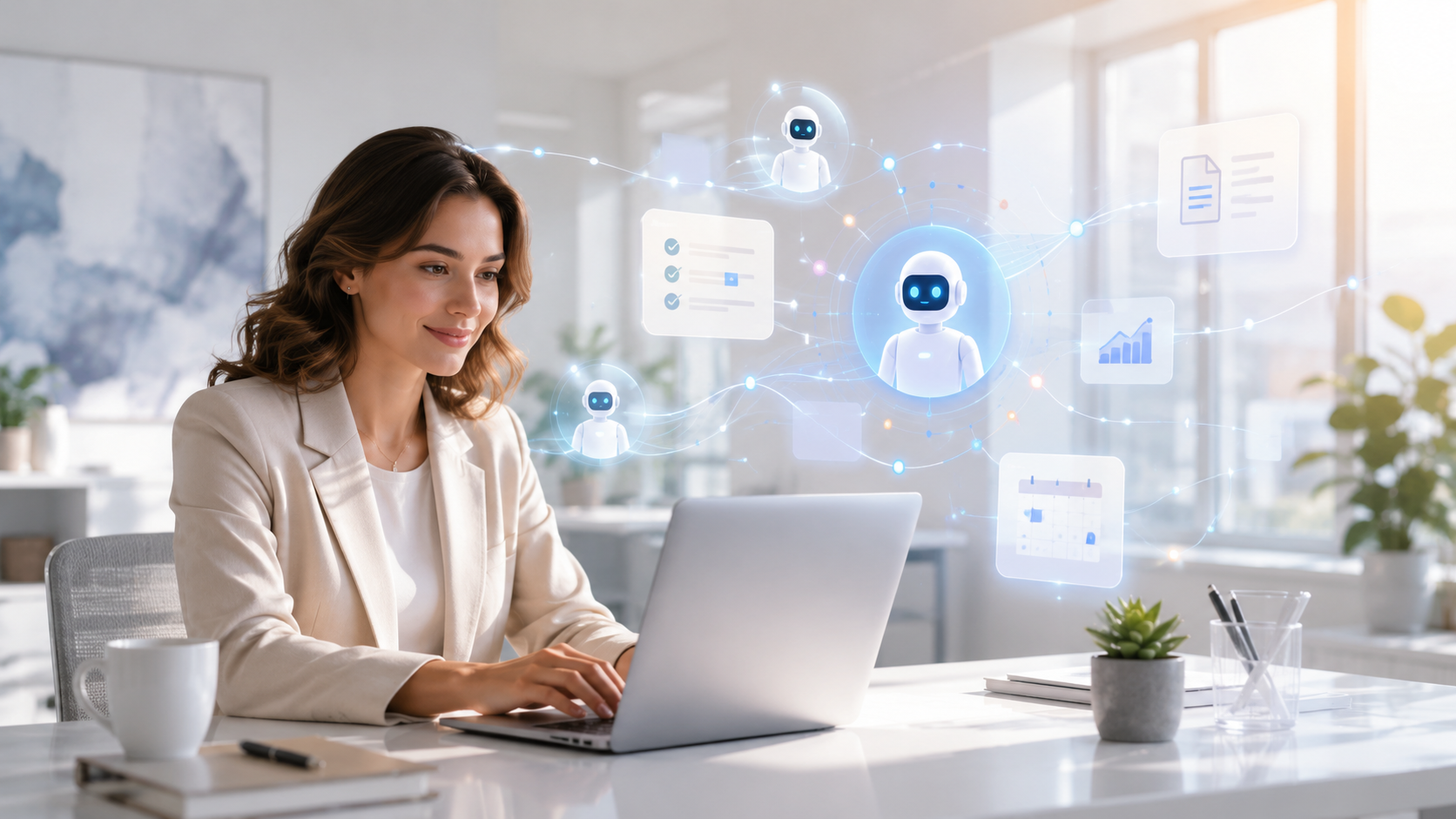
Now imagine a different instruction. We could ask an agent to review our email periodically, classify messages that do not require attention, identify those that need a decision, consult related information when necessary, prepare draft replies, and show us only the matters where we genuinely need to intervene. Some categories might always require our authorization before a reply is sent, while other routine actions could be executed automatically.
In both cases we are using artificial intelligence, but the working model is completely different. In the first case, we use a tool whenever we need something. In the second, we have defined a responsibility and allowed a system to manage part of the work within previously established limits.
OpenAI currently describes an agent as a system that combines a trigger, a process that may incorporate specialized skills, and tools or systems it can connect to. A task may begin because a person initiates it, because a particular event occurs, or because it runs according to a schedule. From there, the agent can consult information, evaluate what it finds, and use authorized tools to complete the work.
The fundamental difference can be summarized simply: when we use a chatbot, we delegate a response; when we use an agent, we begin to delegate an objective.
From Personal Assistant to Digital Employee
The term “digital employee” may sound exaggerated and, of course, an artificial intelligence system is not an employee in the legal, social, or human sense of the word. Nevertheless, the comparison is useful for understanding the change that is taking place. A traditional program usually performs a specific function when someone uses it. An agent, by contrast, can be given a relatively broad responsibility, have access to the tools required to carry it out, and return to the user only when it needs a decision, encounters an exception, or completes the work.
Consider a small company that needs to find a new supplier. Today, someone may spend several hours searching for companies, reviewing websites, requesting quotes, organizing the information in a spreadsheet, comparing prices, checking delivery times, and preparing a summary so that someone else can make the final decision. Each of these activities may seem small, but together they represent a considerable amount of time.
An agent could be given a more general objective: find suppliers that meet certain requirements, discard those that do not operate in the required region, compare prices and conditions, identify potential risks, and present three reasonable alternatives with their advantages and disadvantages. If it also had authorized access to email, it could even prepare requests for quotations; if it had access to the calendar, it could propose dates for meetings with the finalists; and if it could consult internal documentation, it could check which requirements the company normally uses.
At that point, we are no longer talking simply about a tool that helps us write. We are beginning to approach something more like a digital collaborator specialized in a particular function.
The Real Revolution Is Connecting Intelligence to Tools
An isolated language model can know a great deal and reason over large amounts of information, but its ability to truly transform work is limited if it cannot interact with the systems where that work actually takes place. An artificial intelligence system may be perfectly capable of explaining how to organize a meeting, but if it cannot consult our calendar, check participants’ availability, or create the event, we are still the ones who must complete the process.
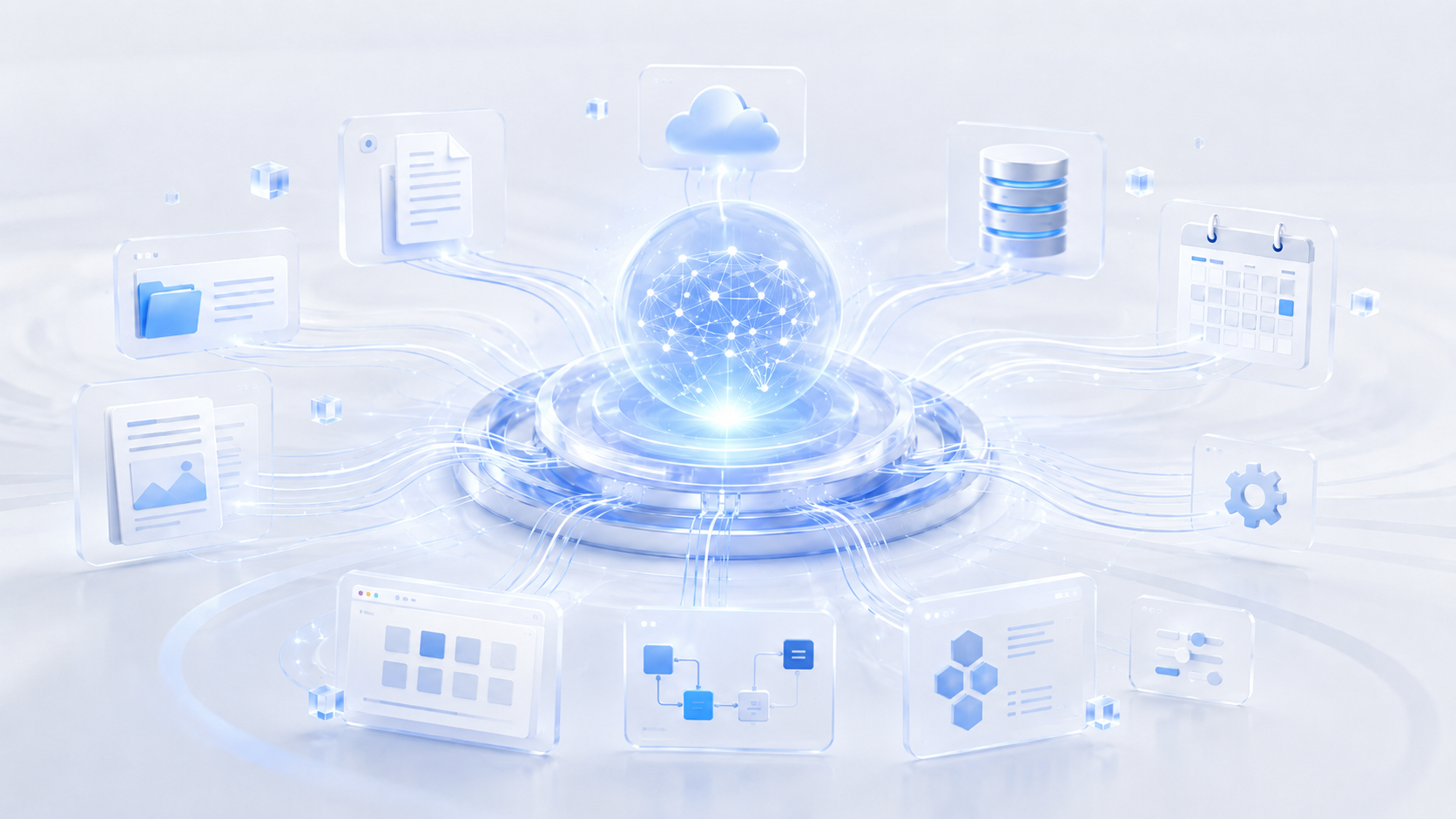
That is why agents need tools. These tools can allow them to retrieve information, read documents, search databases, access business systems, or perform certain actions. OpenAI distinguishes, for example, between tools that retrieve data, tools that act on other systems, and mechanisms through which an agent can even use other specialized agents to complete more complex tasks.
The consequence is important because it changes the nature of artificial intelligence itself. A model without access to its environment can tell us what we should do. A connected system can begin to do it.
This transition also explains why, in recent years, so much attention has been paid to connections between AI models and business applications. Email, calendars, documents, databases, customer relationship management systems, design tools, internal applications, and cloud services contain precisely the information and actions that can turn an intelligent response into completed work.
Automating a Procedure Is Not the Same as Delegating an Objective
Automation did not begin with artificial intelligence. For decades, companies have used macros, scripts, and different systems to reduce repetitive work. More recently, platforms such as Zapier, Make, and n8n popularized the ability to connect applications and build workflows without having to develop large amounts of software.
The traditional principle of automation is relatively simple. If a particular event occurs, we execute a predefined action. When a form arrives, we save the data in a table; when a new invoice appears, we copy it into a folder; when a customer makes a purchase, we send a specific email. The path has already been designed by a person, and the system simply follows it.
Agents introduce a fundamental difference because part of the path can be decided during execution. Anthropic distinguishes specifically between workflows, in which models and tools follow paths defined in advance through code, and agents, in which the model itself dynamically determines how to use tools and which steps to take in order to reach the objective.
This means that if one source of information is unavailable, an agent can try to find another; if it encounters contradictory data, it can compare the sources; if essential information is missing, it can request it; and if a particular action fails to produce the expected result, it can modify its strategy. It does not necessarily follow one rigid sequence, but instead operates within an allowed space of possible actions.
The conceptual difference is enormous. Traditional automation consists primarily of programming a procedure. Agents allow us to begin delegating an outcome.
When One Agent Uses Other Agents
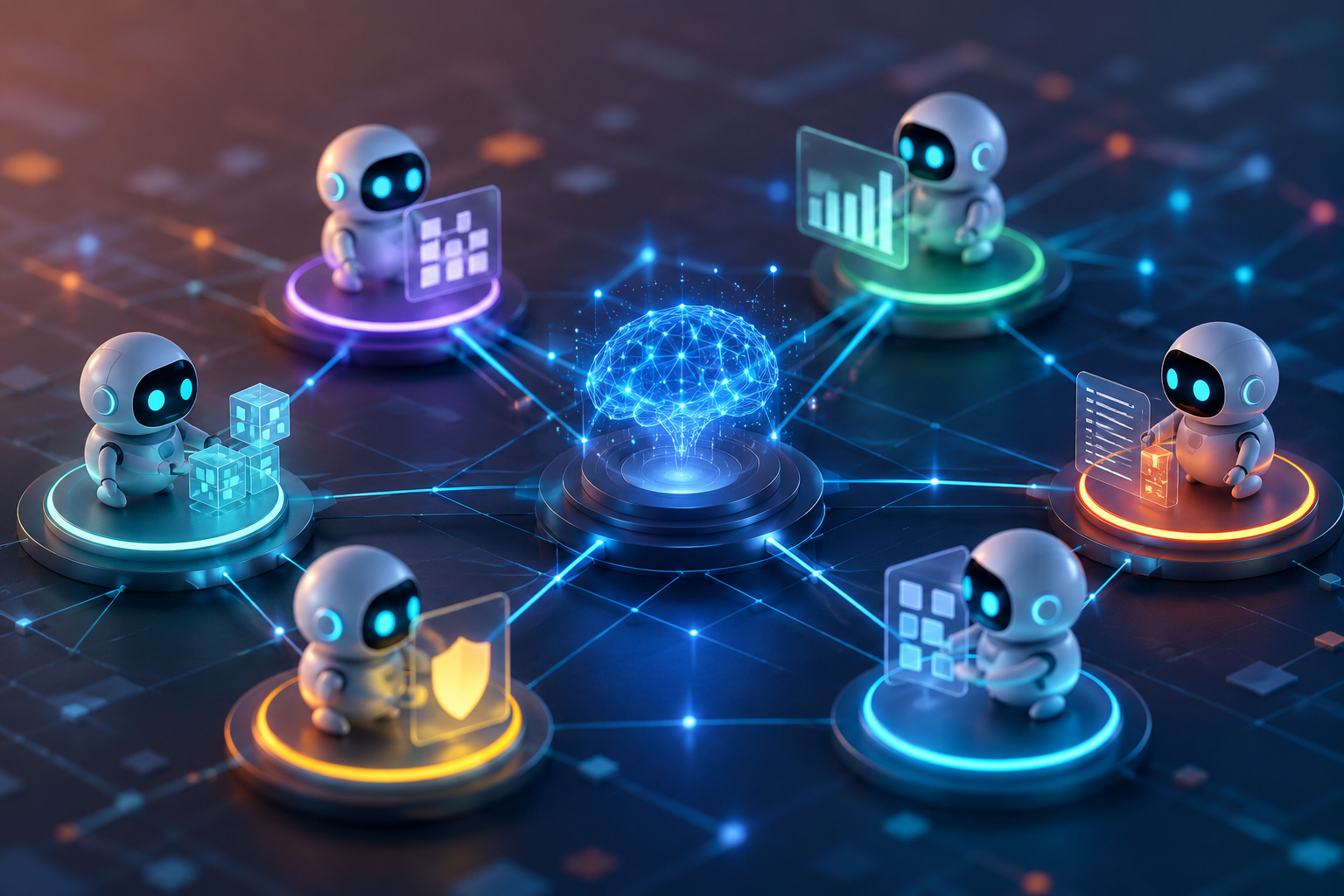
The next step is even more interesting. If an agent can use tools, there is nothing to prevent one of those tools from being another specialized agent. Instead of building a single system responsible for understanding every part of a problem, we can imagine small digital teams in which different agents perform different functions.
A primary agent could receive a project and divide it into different activities. One agent could research suppliers, another analyze the budget, another consult legal documentation, another review the calendar, and another prepare the final presentation. The coordinating agent would then bring the information together, identify inconsistencies, and present the human decision-maker only with those issues that require approval.
We do not need to imagine an extraordinarily advanced artificial intelligence to understand the organizational consequences of such a system. Many companies are already made up of specialists who perform different tasks and coordinate their results through emails, documents, meetings, and management applications. If part of that coordination can take place between digital systems at vastly greater speed, the amount of time spent moving information between people could be reduced considerably.
Anthropic currently describes architectures ranging from single-agent systems to coordination models involving multiple agents, using sequential, parallel, and evaluation-based patterns. The goal is not simply to use the most complex architecture possible, but to find the one that provides enough value to justify the additional complexity.
This point is particularly important because the arrival of agents may also create a new form of technological enthusiasm: attempting to turn every imaginable process into an agent, even when conventional automation, or even a simple application, could solve the problem more reliably and economically.
Not Everything Needs an Agent
The ability of artificial intelligence to decide how to complete a task may seem automatically superior to a traditional process, but that is not always the case. Precisely because agents have greater freedom to choose their actions, they are also less predictable than a fully defined sequence.
If a company needs to copy exactly the same piece of data from one application to another every night, it probably does not need an agent to reason about the task. A conventional automated process can perform it more cheaply, quickly, and predictably. Additional intelligence begins to make sense when there are exceptions, unstructured information, decisions that depend on context, or paths that cannot be fully determined in advance.
Anthropic specifically recommends starting with the simplest solution and increasing complexity only when necessary. Agentic systems can provide greater flexibility and problem-solving ability, but that advantage usually also involves higher costs, longer execution times, and new difficulties in verifying that the system behaves correctly.
In other words, the question should not be “How can I turn this process into an agent?” but rather “Is there enough uncertainty or need for reasoning here for an agent to provide a real advantage?”
The Hybrid Company Is Beginning to Look Less Like Science Fiction
For years, we mainly talked about artificial intelligence as an individual tool. Each worker would have a personal assistant to help them write better, find information more quickly, or automate certain tasks. That stage will continue, but technology companies are beginning to envision a second phase in which agents stop being isolated personal tools and start becoming part of the organizational structure itself.
Microsoft’s 2025 Work Trend Index reported that 82% of surveyed business leaders expected to use “digital labor” to expand the capacity of their workforce over the following 12 to 18 months. Microsoft described an evolution from individual employees assisted by AI toward teams made up of humans and agents, and later toward organizations in which people set direction while digital systems execute an increasing proportion of the processes.
One year later, the 2026 Work Trend Index developed this idea further. Microsoft argues that, as agents take on a greater share of execution, the human role may gradually shift toward directing work, making decisions, and taking responsibility for outcomes.
This does not mean that offices will be empty in 2027 or that every company will replace its departments with autonomous systems. It means that a different structure is beginning to emerge, one in which we may need to stop counting only how many people are on a team and also begin considering how much digital capacity each of them has available.
A department of five people supported by twenty specialized agents does not operate in the same way as a traditional five-person department. Nor does it automatically mean that the department is equivalent to twenty-five workers. Human and digital capabilities are different. Nevertheless, the organization of work is inevitably beginning to change.
The Worker May Become a Director of Agents
This transformation may also change the meaning of certain professions. For much of our working lives, we have been the ones directly carrying out a large number of tasks. In an environment with agents, part of our work may begin to resemble managing a small team.
A marketing manager might set objectives while different agents research trends, analyze previous results, study competitors, prepare proposals, and generate different alternatives. An architect could request regulatory analysis, document comparisons, or initial explorations before personally reviewing the results. A sales manager might use systems that review clients, identify opportunities, prepare information before a meeting, and later update specific records.
This requires a different skill from simply knowing how to use a program. Directing an agent means learning how to define objectives correctly, provide context, establish limits, verify results, and decide when human intervention is necessary. An instruction that is too vague may produce useless results, while a system constrained by too many rules may lose precisely the flexibility that justified using an agent in the first place.
Over the coming years, a new form of professional literacy is likely to emerge around this capacity for delegation. It will not be enough to know how to “use AI.” We will need to learn which tasks are worth delegating, how much context a system needs, what level of autonomy is reasonable, and how to evaluate its work.
Autonomy Needs Limits
There is a fundamental difference between an artificial intelligence system that drafts text and one that can perform actions on our behalf. The first can produce an incorrect answer. The second can turn that incorrect answer into a real-world action.
An agent connected to email could send a message to the wrong person. One connected to company documentation could share confidential information. A system with excessive permissions could modify records it should not touch or execute a malicious instruction encountered on a webpage. The greater the ability to act, the greater the attention that must be paid to permissions, security, supervision, and traceability.
Anthropic noted in April 2026 that the very autonomy that makes agents useful also introduces new risks, because agents may misunderstand user intent or be manipulated through attacks such as prompt injection. The company identifies several fundamental principles, including keeping people in control, protecting privacy, securing agent interactions, and ensuring sufficient transparency around their actions.
OpenAI similarly emphasizes the need for safeguards that restrict available actions, request confirmation for certain operations, and maintain human oversight in sensitive activities.
The central idea is simple. Delegating a task does not mean granting unlimited authority. In the same way that a company does not give every employee access to all of its accounts, documents, and systems, it would make little sense to give an agent more permissions than it needs to perform its function.
The Goal Is Not to Remove Humans From the Process
When autonomous agents are discussed, it is easy to imagine that the ultimate goal is to eliminate human involvement altogether. Yet the most useful transformation is probably something different. In many activities, we do not need to disappear from the process; we simply need to intervene only at those moments when we genuinely add value.
If a system can analyze one hundred documents, we do not necessarily need to read all one hundred. We can review the exceptions it has identified. If it can compare twenty suppliers, we do not need to visit twenty websites ourselves. We can study the three most interesting candidates. If it can prepare different financial scenarios, we do not need to perform every calculation manually, but we still have to decide what level of risk we are willing to accept.
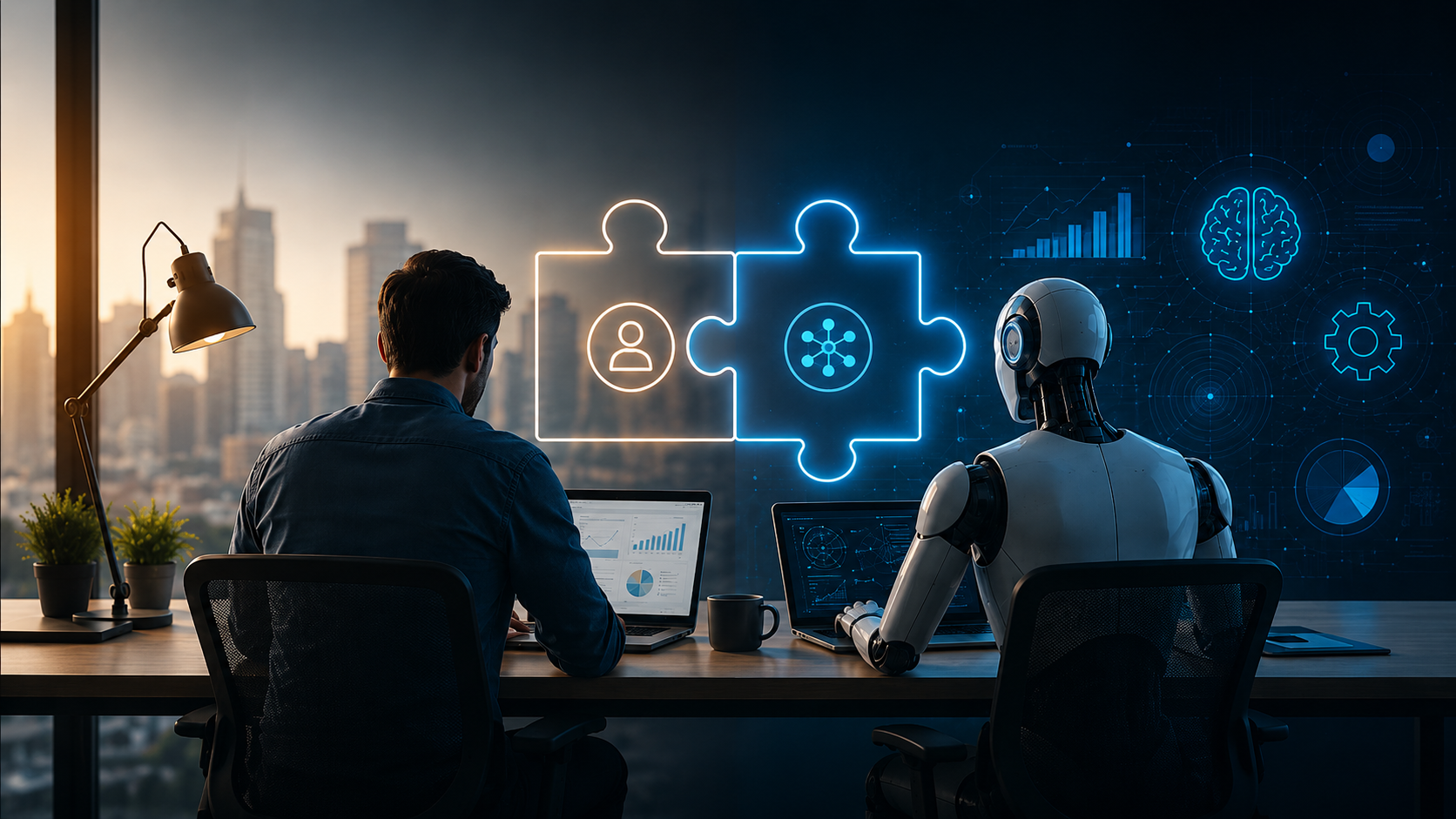
The most productive relationship may therefore consist of distributing work according to the strengths of each side. Machines can analyze large quantities of information, execute repetitive processes, maintain continuous attention over certain systems, and generate numerous alternatives. People remain responsible for setting priorities, interpreting consequences, negotiating, understanding values, building relationships, and deciding which outcomes are truly acceptable.
That is why the company of the immediate future will probably not simply be an automated company, but a hybrid company.
From Software as a Tool to Software as a Collaborator
For decades, our relationship with computers followed a relatively consistent principle. We opened a program and told it exactly what we wanted to do. We selected a tool, clicked a button, changed a parameter, and observed the result. Even the most sophisticated automations generally operated within processes that someone had designed in advance.
Agents are beginning to introduce a different relationship. Instead of specifying every action, we begin to describe objectives. Instead of continuously controlling the procedure, we define boundaries and review outcomes. Instead of using software only as a tool, we can begin to use certain systems as specialized digital collaborators.
This change will probably be gradual and full of errors, exaggerations, and experiments that do not work. Many processes currently presented as fully autonomous will continue to require human supervision for quite some time. Some companies will discover that they have delegated too much, while others will find that certain tasks can be automated far more extensively than they expected.
Nevertheless, the overall direction is becoming difficult to ignore. We have moved from computers that executed instructions to systems capable of interpreting language. Now we are moving from systems that interpret language to systems that can use it to act in the digital world.
The important question will no longer be only what an artificial intelligence can answer, but what we are willing to allow it to do on our behalf.
And when that question becomes part of the everyday organization of a company, we may stop thinking of AI simply as a program we use from time to time. We may begin to see it as a new layer of digital labor that works alongside us, carries out tasks, coordinates processes, and gradually changes the way we understand an organization. The real leap, therefore, is not about having a smarter chatbot. It is about moving from an artificial intelligence we ask what we should do to an artificial intelligence capable of helping us do it. And that seemingly small difference may ultimately transform the way we work.
Recent Posts