AI Isn’t Coming to Take Your Job, But...
AI Isn’t Coming to Take Your Job, but It Is Coming to Change How Many People Are Needed to Do It
For decades, when we talked about automation, we mainly imagined factories, assembly lines, robotic arms moving parts, and machines performing repetitive physical tasks. As those technologies began transforming industry, people who worked in front of a computer could observe that revolution from a relatively comfortable position. Lawyers, architects, engineers, designers, programmers, administrative staff, journalists, consultants, and accountants seemed to belong to a different category. Machines could replace physical strength and repeat movements with precision, but knowledge, reasoning, and creativity still appeared to be fundamentally human domains.
Generative artificial intelligence is now challenging that distinction. For the first time, some of the tasks machines can perform most easily are not found in a factory, but inside a computer. Reading documents, comparing contracts, analysing a spreadsheet, writing an email, searching for information, preparing a report, summarising a meeting, generating code, organising data, or creating a presentation are tasks that, until very recently, necessarily required human involvement and can now be performed, at least partially, by artificial intelligence systems.
This does not mean that all these professions are about to disappear. The transformation may be more gradual and, precisely for that reason, much deeper. The truly important question may not be whether artificial intelligence can completely replace a lawyer, an architect, or a programmer, but what happens when a significant share of the tasks they perform can be completed in a fraction of the time they once required. If ten people can begin producing what previously required twenty, the economic structure of many organisations starts to change even if no profession disappears entirely.

The Problem Is Not That AI Can Do Your Entire Job
One of the questions that has been repeated most often since the emergence of ChatGPT and other generative systems seems straightforward: “Can artificial intelligence do my job?” Yet this is probably too limited a way of understanding what is happening, because virtually no profession consists of a single, perfectly defined activity.
An architect does not simply draw plans. They also interpret regulations, speak with clients, coordinate engineers, explore alternatives, visit construction sites, identify problems, and make decisions that depend on context. A lawyer does not simply draft legal documents, but evaluates risks, interprets ambiguous situations, develops strategies, and assumes responsibility for the advice they provide. The same is true of doctors, engineers, designers, consultants, and programmers. In all these professions, some relatively structured tasks can be automated, while others depend on experience, judgement, human relationships, or responsibility.
For that reason, replacing an entire profession may be far more difficult than automating some of the tasks within it. From an economic perspective, however, that distinction does not necessarily protect the current number of jobs. If a company today needs ten people to handle a particular combination of analysis, documentation, communication, coordination, and administration, and a few years from now those same tasks can be carried out by six people assisted by artificial intelligence, the profession will still exist, but the number of professionals required will have changed.
The opposite could also happen. A company might keep those ten employees and use the increase in productivity to take on more projects, enter new markets, reduce costs, or create services it could not previously afford to offer. Technology does not automatically determine which of these paths will be taken. That will depend on competition, economic conditions, business decisions, and the speed at which each sector adopts these tools.
What is genuinely new is that a relationship that once seemed almost inevitable is beginning to break down: producing substantially more intellectual work no longer necessarily requires hiring substantially more people.
The Office Has Become One of the First Frontiers of Automation
For years, it was assumed that manual jobs would be the first to be affected by advanced automation. Yet there is a very simple reason why office work is undergoing such rapid transformation: artificial intelligence already exists in the same environment in which millions of professionals work.
An AI model does not need to learn how to walk in order to open a document, nor does it need to develop a robotic hand capable of using a keyboard. It does not need to move physically in order to analyse a thousand emails, compare hundreds of contracts, or examine a spreadsheet. That entire world already exists in digital form and is therefore far more accessible to a system capable of processing language, images, data, and code.
This becomes even more important when we look at how a modern working day is actually distributed. Research published by Microsoft in 2023 showed that the average worker studied spent approximately 57% of their digital activity on meetings, emails, and chats, while around 43% was devoted to creating documents, spreadsheets, and presentations.
That figure raises a possibility far more interesting than simply using artificial intelligence to write an email faster. Perhaps the real transformation will not consist of producing the same presentations, documents, and messages in less time, but in discovering that a significant proportion of them are no longer necessary.
A large part of the activity within a modern company exists simply to coordinate the work of one person with another. Someone requests information, another person prepares a document, someone reviews the budget, a question arises, an email is sent, a meeting is scheduled, the document is subsequently revised, a new version is prepared, and finally someone creates a presentation to explain what has been decided. None of those people is necessarily working inefficiently. The problem is simply that coordinating human beings requires an enormous amount of communication.
If different AI agents could consult documents, check budgets, review calendars, analyse alternatives, and return to the person in charge only those decisions that genuinely require human approval, a considerable part of that coordination could disappear. In such a scenario, productivity would not increase merely because we could write twenty emails more quickly. It would increase because perhaps those twenty emails would no longer need to be written at all.
Layoffs Are Already Part of the Conversation, but the Reality Is More Complex
This transformation has inevitably become intertwined with news about workforce reductions. In January 2026, Amazon confirmed approximately 16,000 additional corporate job cuts as part of a broader restructuring while the company continued to increase its investment in artificial intelligence and automation. The case was immediately interpreted as a sign of what might happen across many large companies over the coming years.
However, it would be a mistake to treat every layoff that occurs during this technological revolution as a direct consequence of AI. Companies reduce their workforces for many reasons, including changes in demand, internal restructuring, mergers, cost-cutting, new business strategies, or changes in relationships with major customers. UPS, for example, announced significant workforce reductions during 2026, but much of that decision was related to the deliberate reduction of the delivery volume it handled for Amazon.
Klarna provides an especially interesting example because it shows that the story is not simply about replacing workers with machines. For a time, the company became one of the most frequently cited examples of aggressive AI adoption in customer service and other areas. It later acknowledged that some of its cost-cutting measures had gone too far and began restoring greater human involvement in certain parts of its customer service operation.
The lesson is important because it reminds us of something that can easily be lost amid technological enthusiasm: the fact that an activity can be automated does not necessarily mean that it should be automated completely. A machine may perform a task more cheaply and still create a worse customer experience, make errors that are difficult to detect, or remove a human relationship whose value had initially been underestimated.
A New Industrial Revolution, but With One Fundamental Difference
Comparing artificial intelligence with the Industrial Revolution may seem exaggerated, but there is a reason the comparison appears so often. The major technologies of history have expanded different human capabilities. The steam engine multiplied our physical strength, electricity transformed our industrial capacity, computers expanded our ability to process information, and the Internet multiplied our ability to communicate. Artificial intelligence introduces a different possibility: beginning to reduce the cost and dramatically increase the scale of certain forms of intellectual work.
Until now, if an organisation wanted to significantly increase its intellectual capacity, it essentially had one solution: hire more people. A consultancy that needed to conduct ten times as much analysis required many more analysts; a software company that wanted to produce substantially more code had to expand its development team; and an architectural practice seeking to manage more projects needed to hire more architects, draughtspeople, and other specialists.
Artificial intelligence may weaken that relationship between the number of employees and the amount of output. A professional assisted by systems capable of conducting research, analysing documents, generating alternatives, and producing first drafts can perform activities that previously would have required several people working together. Likewise, a small team can manage quantities of information and levels of operational complexity that only a few years ago would have required entire departments.
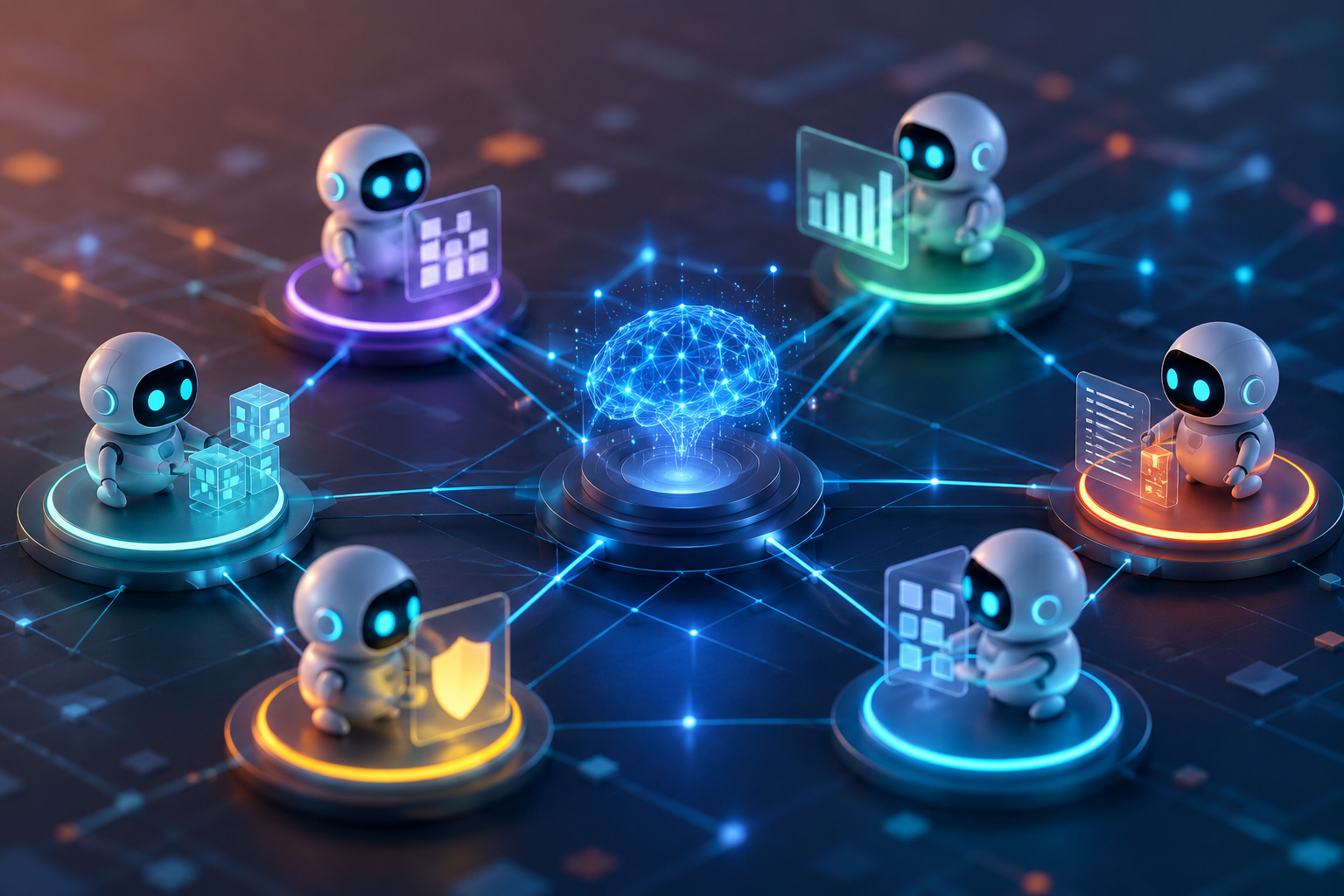
This does not necessarily mean the end of large companies, but it may encourage the emergence of much smaller and extraordinarily productive businesses. We can imagine organisations made up of only a handful of experienced people, supported by a strong brand, specialised knowledge, and a commercial network, while numerous digital agents take responsibility for research, organisation, analysis, document preparation, and the coordination of different processes.
A ten-person company capable of producing what once required a hundred employees could be just as economically disruptive as a fully automated company, and it is probably a far more realistic scenario for the years immediately ahead.
The Surprising Advantage That Experience May Provide
This transformation also creates an interesting paradox. For a long time, we assumed that younger generations would automatically enjoy a technological advantage because they grew up surrounded by new tools. In some respects that will remain true, but artificial intelligence is beginning to reduce the distinctive value of certain technical skills while simultaneously increasing the value of something acquired primarily over time: professional context.
Building a simple website is a good example. Until recently, it was necessary to learn different languages and technologies before being able to create even a relatively basic prototype. Today, there are tools that allow someone to describe an application in natural language and obtain an initial functional version within minutes. This does not automatically turn anyone into a software engineer, because a business application still requires security, architecture, testing, maintenance, scalability, and a deep understanding of the problem. It does, however, partially reduce the barrier between knowing what we want to build and knowing exactly how to program it.
As that barrier falls, experience may become extraordinarily valuable. An architect who has worked for twenty years knows which problems tend to emerge during construction and can recognise solutions that work perfectly on paper but fail in practice. An experienced salesperson can sense when a client is losing interest even before they say so. A lawyer knows about ambiguous situations that are rarely explained completely in a textbook, while an engineer may recognise a technically correct solution that will ultimately be too expensive, too complicated, or too difficult to maintain.
Artificial intelligence can possess enormous quantities of information, but possessing information is not the same as understanding which problem is actually worth solving. In that environment, an experienced specialist who learns to work with AI may become an especially powerful figure. They may not be the best programmer or the person who knows the most commands, but rather the person who understands what should be built, why it should be built and, above all, how to determine whether the result actually makes sense.
The Biggest Problem May Appear Precisely Among Those Who Are Just Starting Out
This advantage of experience leads, however, to another and much more difficult question. How does a new generation of professionals acquire experience if precisely the tasks through which that experience was traditionally gained begin to disappear?
For decades, many professions have operated through a kind of ladder. Younger employees began with relatively simple activities: preparing documents, searching for information, organising data, checking results, and producing first drafts. These were not necessarily the most interesting tasks, but they allowed people to observe how experienced specialists worked, make relatively small mistakes, and gradually understand how the profession actually functioned.
Many of those entry-level activities are precisely the tasks that artificial intelligence can automate most easily. If we eliminate them completely, we may find ourselves facing a difficult paradox within a few years: companies will still need experienced specialists, but there will be fewer opportunities for anyone to become one.
For that reason, the way we train new professionals will probably also have to change. Instead of spending years carrying out routine tasks before being allowed to participate in important problems, younger workers may need to become involved much earlier in real processes of analysis, supervision, decision-making, and verification. Part of professional training may consist precisely of learning how to review work produced by artificial intelligence systems, understand why an apparently correct answer may nevertheless be wrong, and identify which elements of context the machine has failed to consider.
Knowing how to use AI is not simply a matter of knowing how to ask a good question. It also means knowing when we should not trust the answer.
The Easier It Becomes to Generate an Answer, the More Valuable It Becomes to Know How to Evaluate It
During the early years of generative artificial intelligence, one apparently logical idea emerged repeatedly: if anyone can ask an AI a question and receive a sophisticated answer, perhaps specialists will become less important. In some sectors, exactly the opposite may happen.
When producing a first version of something becomes extremely cheap, value may shift from production toward evaluation. Generating a contract may become increasingly simple, but determining whether that contract actually protects our interests will continue to require legal expertise. Creating a plan may take only minutes, while knowing whether it can be built safely and efficiently remains another matter entirely. Generating thousands of lines of code may become easy; determining whether that code contains vulnerabilities, can be maintained, or genuinely solves the problem will become far more important.
Artificial intelligence can dramatically reduce the cost of producing alternatives, but it does not automatically remove the responsibility of deciding between them. The more content we are able to generate, the greater the need for people capable of distinguishing what is correct from what merely appears plausible, and those two things are not always the same.
The Professional Who Knows How to Work With AI
A phrase has been repeated constantly in recent years: “AI won’t replace you; someone who knows how to use AI will.” It is an oversimplification, because an economic transformation of this scale can hardly be reduced to a single sentence, but it contains an important insight.
Over the coming years, productivity differences between professionals with similar levels of knowledge are likely to increase significantly. One person may continue carrying out all their activities exactly as before, while another uses artificial intelligence to conduct research, prepare first drafts, compare alternatives, automate repetitive tasks, identify inconsistencies, and analyse large quantities of information.
That does not mean we all need to become artificial intelligence engineers. In the same way that we use computers today without understanding the internal workings of a processor, most professionals will probably use these systems without knowing the mathematical details of the models behind them.
What we will need to learn is what can be delegated, what must be verified, what information should not be shared, where human authorisation needs to remain in place, and which decisions make no sense to hand over completely to a machine. Working with artificial intelligence may become a form of basic professional literacy comparable to learning how to use a computer or the Internet. It will not necessarily be a profession in itself, but a cross-disciplinary capability embedded in many existing professions.
Will There Be Fewer Jobs?
It is almost inevitable that some activities will disappear and that other professions will change considerably. New occupations will also emerge, just as they did during every previous major technological transformation. The World Economic Forum’s Future of Jobs Report 2025 estimated that, taking artificial intelligence together with other major economic and demographic transformations, around 92 million jobs could disappear by 2030 while approximately 170 million new jobs could be created, resulting in an overall positive balance.
However, aggregate figures can hide the problem that truly matters. For a person who loses their job, it is of little comfort that an international statistic indicates that new jobs are simultaneously being created in another sector, another country, or for workers with completely different skills. Economies can readjust over time, but people need to learn, adapt, pay their bills, and find opportunities while that adjustment is taking place.
For that reason, perhaps the greatest difficulty will not be determining whether there will be more or fewer jobs in absolute terms twenty years from now. The immediate challenge will be managing the transition from one employment structure to another, particularly if change occurs faster than educational systems, companies, and governments are able to adapt.
The Question We Should Start Asking
As the capabilities of artificial intelligence continue to grow, many people will inevitably watch new demonstrations and once again ask whether a machine can do their job. Yet there is probably a much more useful question: which parts of my work can a machine do better, and which parts become even more valuable precisely because they require a human being?
Preparing and classifying information can increasingly be automated, while choosing objectives remains a decision. Generating alternatives can become extraordinarily cheap, but accepting responsibility for choosing one of them still belongs to someone. Responding to messages can be automated, while building a relationship based on trust is far more complex. Analysing millions of data points may be an ideal task for a machine, but determining which result deserves our attention depends on priorities, experience, and values.
The artificial intelligence revolution will probably not arrive in the spectacular way we often imagine. We will not walk into the office one morning and discover a robot sitting in our chair. The transformation will be much more gradual. First, a task that once required twenty minutes will be completed in two. Then the same will happen with another. Later, an entire process may become automated and, some time after that, a company may discover that a team of five people can manage an activity that previously required fifteen.
At that point, we will understand that the true transformation was never exclusively about replacing human beings with machines. It was about changing the relationship between work, knowledge, time, and productivity.
Artificial intelligence does not need to learn how to perform absolutely every part of our jobs in order to transform our professions. It only needs to perform a sufficiently important share of the tasks that make them up. That is why the best preparation for the years ahead will probably not consist of trying to compete with machines at the activities they can perform faster, but rather of learning how to use them to expand our own capabilities while strengthening those that continue to depend on experience, judgement, responsibility, and human understanding.
Perhaps, then, the truly interesting question will no longer be “Can artificial intelligence do my job?” but something far more useful:
What might I be capable of doing when I have an artificial intelligence capable of working alongside me?
Recent Posts