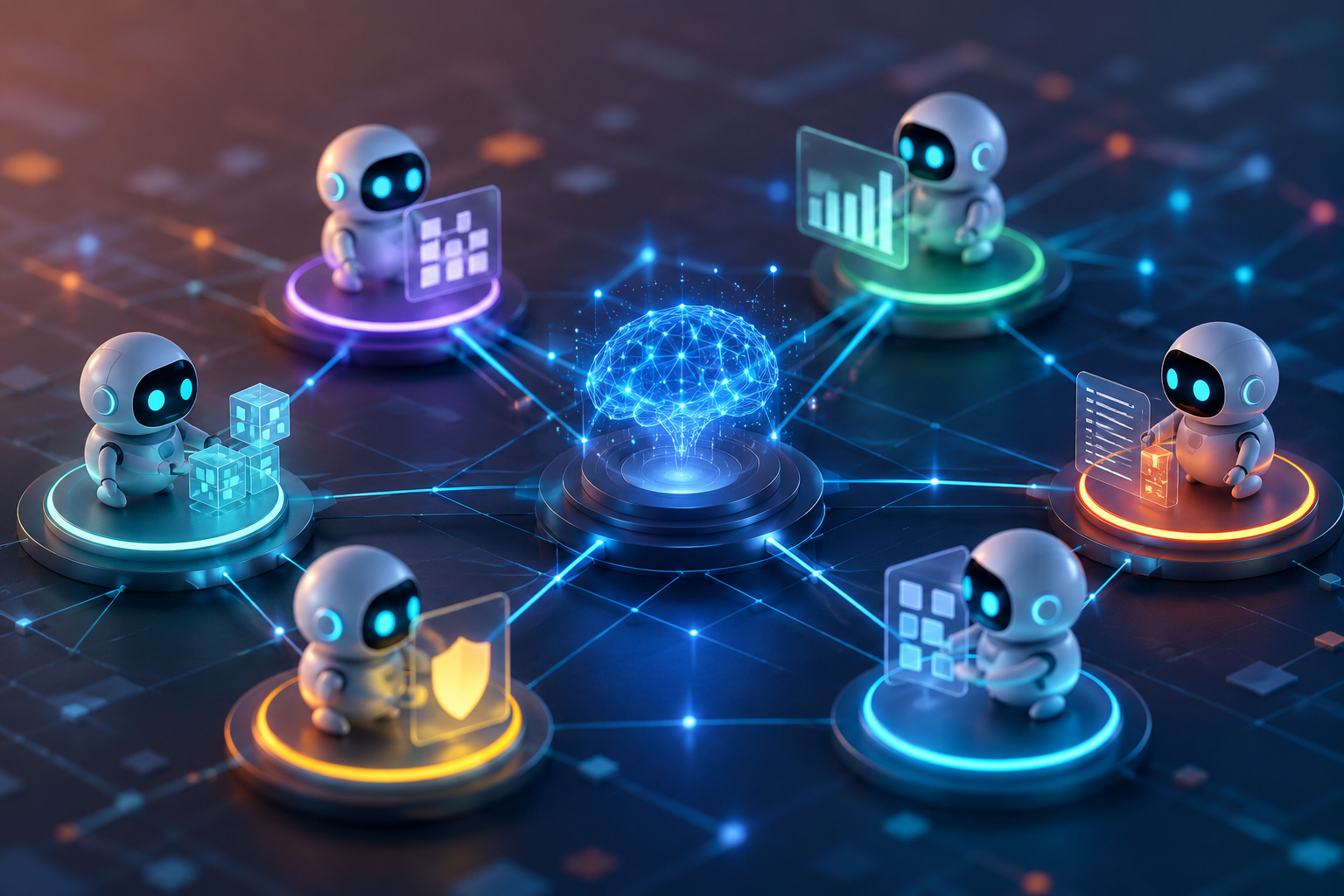
MCP: The Infrastructure That Allows Artificial Intelligence to Connect with the Digital World
MCP: The Infrastructure That Allows Artificial Intelligence to Connect with the Digital World
When we use artificial intelligence to answer a question, translate a text, or summarize a document, it is relatively easy to forget that the model is, in reality, quite isolated. It may possess enormous amounts of knowledge and be capable of reasoning about complex problems, but that does not mean it automatically knows our files, can check our company calendar, review an internal database, or access the tools we use every day.
This limitation becomes especially important when we stop thinking of artificial intelligence as a simple conversational system and begin to imagine agents capable of actually performing work. An agent may know perfectly well how to find a supplier, organize a meeting, analyze a project, or update a sales record, but if it has no secure and standardized way to communicate with the applications where that information resides, we still need to build specific connections for each individual case.
It was precisely to solve this problem that MCP, the Model Context Protocol, emerged. Anthropic introduced the protocol as an open standard in November 2024 with the aim of creating a common way to connect artificial intelligence systems with information repositories, business tools, and development environments. The idea was to reduce a problem that was becoming increasingly obvious: every new combination between an AI system and a data source required a different integration.
MCP attempts to create a common layer between these two worlds. If this infrastructure continues to spread, it may eventually become one of the least visible yet most important components of the transformation driven by AI agents.
The Problem of an Intelligence That Knows a Great Deal but Does Not Know Our World
An artificial intelligence model may have learned enormous amounts of public information and be extraordinarily good at interpreting language, but our everyday work depends largely on private, current, and highly specific information. A company may have contracts stored in a document management system, projects distributed across different applications, commercial data inside a CRM, emails, calendars, databases, technical files, and numerous specialized programs.
Artificial intelligence should not have unrestricted access to all of this content, but neither can it become a truly effective working tool if it remains completely disconnected from it. The challenge is to allow a system to access or use what it needs, when it needs it, and with the appropriate permissions.
Before protocols such as MCP, a company that wanted to connect its AI assistant to five different systems could end up developing five separate integrations. If it later wanted to use another model or add another tool, some of those connections might have to be rebuilt. The larger the ecosystem became, the greater the maintenance problem.
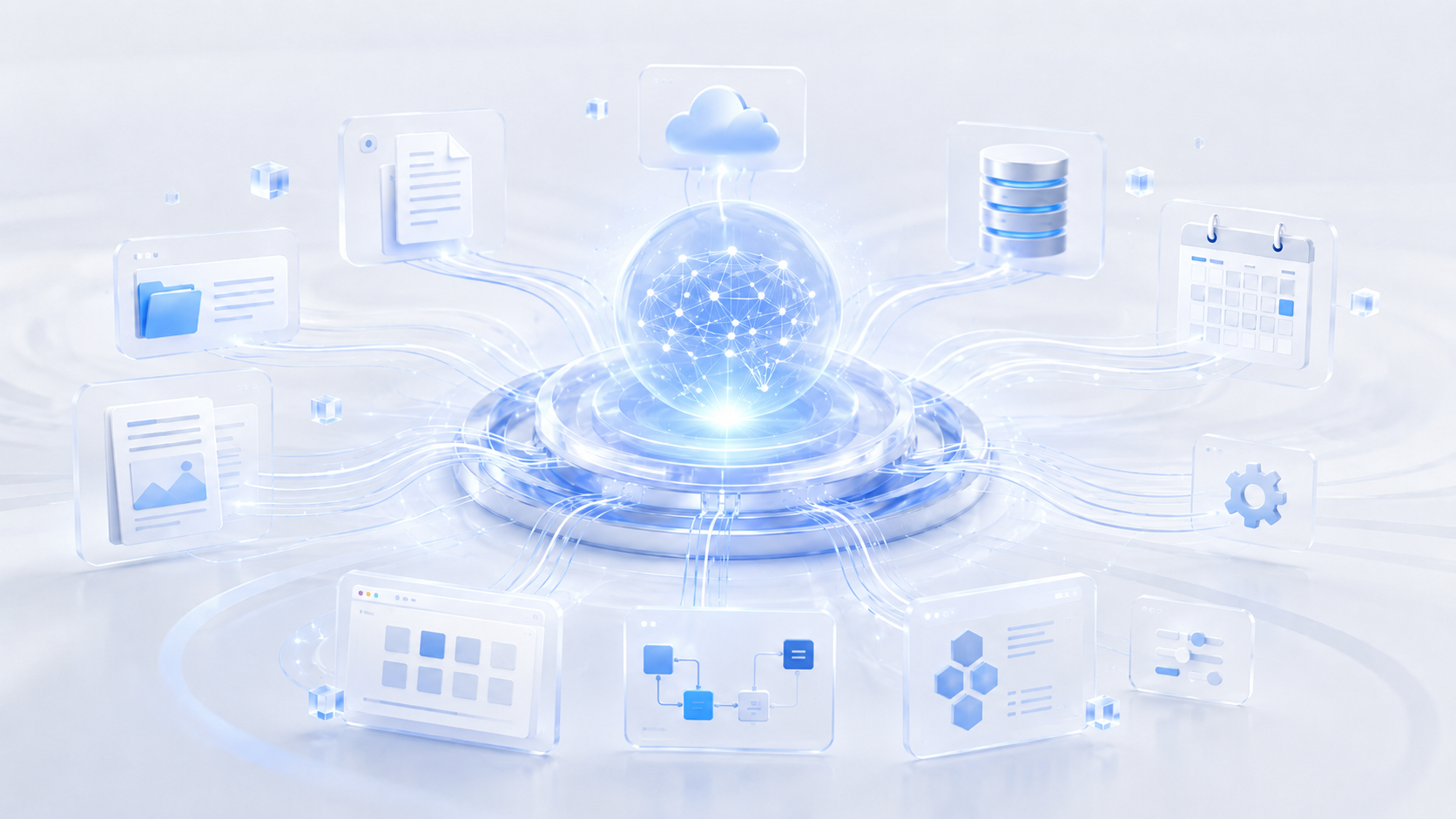
MCP proposes a more standardized architecture. Instead of developing a completely different connection every time we want to link a model with a tool, an application can expose certain capabilities through an MCP server, and compatible AI applications can connect to them as clients. Anthropic described this architecture from the outset as a way to establish open, bidirectional connections between AI-powered applications and the sources where data resides.
The importance of the concept goes beyond making programming easier. If different systems begin to use a common interface, artificial intelligence can gradually become a layer capable of working across many applications without requiring every combination to be invented from scratch.
An Imperfect but Useful Comparison: the USB of Artificial Intelligence
A simple way to explain MCP is to compare it with USB, although technically they are very different things. Before certain connection standards became widespread, devices required a huge variety of cables, ports, and drivers. Each manufacturer solved essentially the same problem in a different way.
Standards did not eliminate the diversity of devices. A keyboard remained different from a camera, and a printer continued to perform a different function from a hard drive. What changed was that they no longer required completely incompatible systems in order to establish a basic connection.
MCP pursues a similar idea within the artificial intelligence ecosystem. A database remains a database, a design program continues to have its own functions, and a customer management system retains its own structure. The protocol does not attempt to turn all of these tools into the same application. Instead, it tries to provide a common way for artificial intelligence to discover which capabilities are available and use them in a structured manner.
For that reason, calling MCP “the USB of AI” is not technically precise, but it helps illustrate its importance. The true value of a standard becomes apparent when we stop thinking about a single connection and begin to imagine thousands of applications capable of understanding the same basic way of communicating.
From Context to Tools
The name Model Context Protocol may suggest that its only purpose is to provide additional information to a model, but the concept has evolved considerably. In its early stages, MCP primarily addressed the problem of connecting models with sources of context. However, as agents have become more important, the protocol has also evolved into an infrastructure for exposing tools and allowing systems to perform certain actions.
We can imagine an MCP server connected to a project management application. This server might indicate that tools are available for consulting tasks, searching projects, creating new items, or updating certain fields. The artificial intelligence would not need to understand internally how the entire application works. It would only need to understand the capabilities the application has chosen to expose and use the appropriate tool when the user requests something.
The distinction is fundamental. An isolated artificial intelligence can explain how to update the status of a project. A connected artificial intelligence may be able to update it itself, provided it has permission to do so.
OpenAI is already using this model within its own integrations. As of August 2026, full MCP support, including modification and write actions, is being rolled out in beta for organizations using certain business ChatGPT plans. These MCP applications can allow ChatGPT to consult corporate systems and also perform actions such as initiating workflows, creating tasks, or updating information in business tools.
We are therefore moving from using artificial intelligence solely to interpret information toward using it as an interface capable of coordinating actions across different systems.
Why MCP Is Especially Important for Agents
In the previous article, we discussed the difference between a chatbot and an agent. A chatbot responds to a specific request, while an agent can receive a broader objective, use tools, and continue working until a task has been completed. This difference makes connectivity far more important.
Imagine an agent responsible for organizing a business trip. To do this properly, it might need to consult the calendar, determine where the meeting is taking place, analyze flights, review internal expense policies, find information about hotels, and finally prepare several alternatives. Without connections to those systems, artificial intelligence can help us think, but we still have to move the information manually from one application to another.
If those services expose compatible capabilities, an agent can begin using different tools as it progresses through the problem. It does not necessarily need to receive all the information from the beginning. It can determine what it needs, retrieve it from the appropriate source, and use it to decide the next step.
This is one of the fundamental transformations taking place in modern artificial intelligence. For years, we tried to place all relevant information inside the model’s context. With agents, we are beginning to build systems in which intelligence can search for and use information when it needs it.
MCP is becoming one of the layers designed to make that relationship possible.
What Really Matters Is Interoperability
New tools and standards appear constantly in technology, and many disappear after a few years. For that reason, the importance of MCP should not be measured solely by its current technical features, but by the level of adoption it manages to achieve.
A protocol of this kind becomes especially valuable when different companies that compete with one another decide to use it. At that point, it stops being simply a feature of one product and begins functioning as common infrastructure.
Since its introduction by Anthropic in November 2024, MCP has spread rapidly across the artificial intelligence ecosystem. At the end of 2025, it became part of the Agentic AI Foundation, created under the Linux Foundation as a neutral space for different projects related to AI agents. MCP was one of the founding projects of this initiative.
This shift is particularly significant. A standard originally designed by one company has a greater chance of becoming cross-industry infrastructure when its governance no longer depends exclusively on that company and instead develops within a broader community.
In practical terms, this means MCP should no longer be understood simply as “Anthropic’s protocol.” Its evolution is being managed through maintainers, working groups, and open processes for proposing changes to the specification.
By 2026, MCP Is Already Considerably Different from the Original Protocol
The speed at which the ecosystem is evolving can be seen simply by comparing the earliest versions of MCP with the specification published on July 28, 2026. That update introduced one of the largest changes since the protocol was created and modified part of its architecture to make it better suited to enterprise infrastructure and distributed systems.
Among the most important changes was a move toward a stateless core designed to work more effectively over conventional HTTP infrastructure. This makes it easier to scale MCP servers without depending on persistent sessions between every client and server. The release also introduced authorization improvements, extension mechanisms, and new capabilities designed for applications and long-running processes.
This may sound excessively technical to someone who simply uses artificial intelligence, but these are precisely the kinds of changes that allow a technology to move beyond the experimental stage and begin operating in real systems with thousands or millions of requests, different authorization levels, and strict reliability requirements.
According to the project’s maintainers, the main MCP SDKs are now recording hundreds of millions of downloads per month, while the TypeScript and Python SDKs have each exceeded one billion cumulative downloads. These figures do not mean there are one billion different users, since a large proportion comes from automated installations and development systems, but they do illustrate how quickly the infrastructure is being incorporated into the technology ecosystem.
MCP Apps and a Boundary That Is Beginning to Disappear
Another particularly interesting development is that MCP connections no longer need to be limited to invisible data and tools. The extension architecture introduced in 2026 includes MCP Apps, which allow servers to provide visual interfaces that can appear directly within the application being used to interact with the artificial intelligence.
This concept may eventually change our relationship with software. For decades, we have constantly switched between programs. If we wanted to review a project, we opened one application; if we needed to check email, we moved to another; to look at a calendar, we used a third; and to analyze a database, we opened a fourth.
Artificial intelligence connected through common protocols can begin to become a layer through which we consult and use different systems without constantly navigating between interfaces. This does not necessarily mean traditional applications will disappear, but it may change where the main point of interaction is located.
Instead of asking ourselves which program we need to open to perform a particular activity, we may simply explain what we want to achieve and allow the system to determine which tools it needs to use.
The primary interface then stops being exclusively an application menu and begins to become our intention expressed through language.
Security Becomes Far More Important When AI Can Act
All of this capability also introduces an obvious problem. The more tools an artificial intelligence can use, the greater the potential consequences of an error.
If a chatbot misunderstands a question and gives an incorrect answer, we can simply ignore it. If an agent misunderstands an instruction and has permission to modify a database, send an email, or change information inside a business system, that mistake can immediately become an action.
For that reason, the security of MCP and other agent infrastructures cannot consist merely of checking whether the connection works. It is necessary to define clearly which user is performing the action, what permissions they have, which server they are allowed to use, which tools are available, and which operations require additional authorization.
The July 2026 specification introduced new measures specifically designed to strengthen authorization and better adapt the protocol to modern enterprise systems. The roadmap published on August 22, 2026 also places agent identity and enterprise security among the main priorities for the next stages of the protocol.
This reveals something important about the evolution of agents. The major challenge is no longer simply making them capable of doing more things. It is increasingly about determining reliably who can do what, using which system, and under what conditions.
A Common Protocol Does Not Eliminate Risk
The existence of a standard does not automatically mean that every MCP server is safe. Precisely because the protocol makes it easier to connect tools with artificial intelligence systems, a badly designed or malicious server could represent a considerable risk.
A user might install an integration that requests excessive permissions. A tool could describe its capabilities in a misleading way. An external source could attempt to manipulate an agent through instructions hidden inside apparently normal content. There is also the classic problem of chains of trust: an application trusts an agent, the agent trusts a tool, and that tool retrieves information from another system.
The security of this new infrastructure will need to combine authentication, least-privilege permissions, supervision, activity logs, and mechanisms that make it possible to understand which actions an agent performed and why.
This transformation resembles what happened to the Internet as it evolved from relatively static pages into systems capable of handling banking, identities, companies, and entire public administrations. The more useful an infrastructure becomes, the greater the incentive both to protect it and to exploit it.
Competition May Shift from Models to Ecosystems
In recent years, much of the conversation about artificial intelligence has focused on comparing models. Which one reasons better? Which one writes better? Which one programs better? Which one has a larger context window?
Those differences will continue to matter, but if models become increasingly interchangeable and all of them can access the same tools through common protocols, another part of the competition may shift toward the ecosystem.
An artificial intelligence that reasons slightly better may be less useful than another one that is perfectly connected to the systems we use every day. For a company, controlled access to internal documentation, calendars, specialized applications, and management systems may provide more practical value than a small difference in benchmark performance.
MCP introduces a particularly interesting possibility here: partially separating intelligence from tools. If a company builds certain connections around an open protocol, it can reduce its dependence on a single model provider and allow different systems to use the same infrastructure.
This does not completely eliminate the problem of vendor lock-in, because each platform will continue to have its own characteristics, but it can reduce the need to rebuild an entire ecosystem simply because a better model appears.
For the User, MCP Will Probably Become Invisible
Most people do not know which protocols their browser uses to load a webpage or which mechanisms allow email to synchronize across different devices. Nor do they need to.
If MCP truly succeeds in becoming common infrastructure, something similar will probably happen. Users will not need to think constantly about MCP servers, tool schemas, or authorization protocols. They will simply see that their artificial intelligence can connect to certain applications and perform certain actions.
The infrastructure will become important precisely because it becomes invisible.
We may be able to say, “Find the latest project budget, compare the changes with the previous version, and prepare a summary for tomorrow’s meeting,” without worrying too much about which application contains each file or how the artificial intelligence connects to it.
Behind an apparently simple instruction, multiple connections, searches, and verification steps may take place. The complexity will still exist, but it will gradually move away from the user and into the infrastructure itself.
The Next Step Is for Agents to Communicate Better with One Another
The evolution does not end with connecting artificial intelligence to applications. As systems composed of multiple agents begin to appear, it also becomes necessary to improve communication between those agents themselves.
The MCP roadmap published on August 22, 2026 identifies agent-to-agent messaging mechanisms, improvements to HTTP transport, enterprise identity and security, and the developer experience as priority areas for future versions.
This is particularly interesting because it shows where the architecture is heading. In the first stage, we needed to provide context to a model. Then we began connecting that model to tools. Now we are beginning to design infrastructure in which agents, applications, and other agents can interact within the same ecosystem.
Artificial intelligence is gradually ceasing to be an isolated application and becoming a layer that connects different components of the digital world.
Perhaps the Real Revolution Is Not the Model
Every few months, a new model appears that outperforms the previous one on certain tests and generates another wave of headlines. It is understandable that we pay attention to these improvements because they are easy to demonstrate. We can watch an artificial intelligence write better, program better, or solve a problem it previously could not solve.
Infrastructure is far less spectacular. A new authorization mechanism, a connection protocol, or a change in the way tools are exchanged hardly creates the same impression as watching a robot walk or seeing an artificial intelligence generate a video in seconds.
Yet the history of technology shows that many of the deepest transformations depended precisely on standards that later stopped attracting our attention. The Internet does not exist because of a single spectacular application, but because of protocols that allow millions of different systems to communicate. The Web was able to expand because common rules existed that allowed people to build upon it.
MCP attempts to solve a similar problem on a much more specific scale: providing a common language through which artificial intelligence systems can discover information and tools and use them.
It is still too early to know whether MCP will ultimately become the dominant standard or whether other architectures will emerge in the future and share that space. What seems much clearer is that the problem it is trying to solve is not going away.
The more capable agents become, the more they will need to connect with our digital world. At the same time, the more connected that world becomes, the less sense it will make to build a completely different integration for every model, every application, and every company.
For that reason, the next great revolution in artificial intelligence may take place somewhere most users will never see. It does not necessarily have to happen inside the model itself, but rather in the infrastructure that allows that model to stop operating in isolation and begin connecting with other intelligences, tools, applications, data, and systems.
And we probably will not have to wait very long to see it. Everything is moving at extraordinary speed, to the point that developments that today seem as though they belong to the coming years may begin to become visible within days, weeks, or months. Claude and ChatGPT are already doing it. In fact, by the time this article is published, there is a very real possibility that some of what it says will already be outdated.
That is how fast this is moving.
Recent Posts